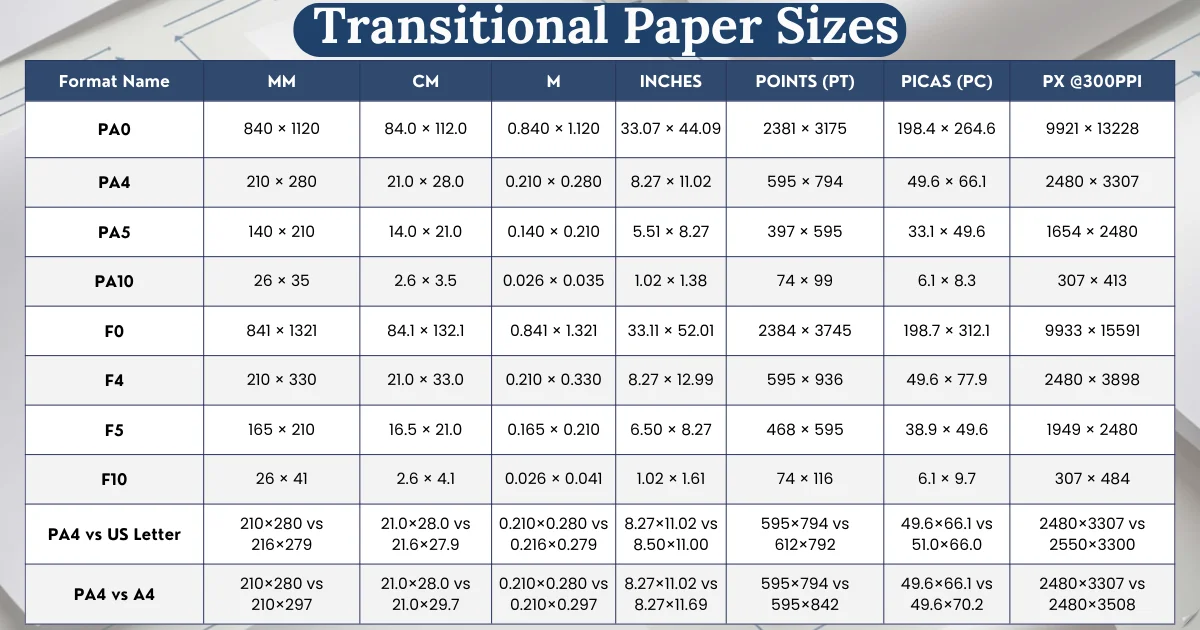
Transitional paper sizes are a unique group of formats that bridge the gap between ISO metric paper standards and North American letter-based sizes. They were never fully standardized — but they never disappeared either.
Two series make up the complete Transitional paper size family — the PA Series and the F Series, totaling 22 individual formats still used across print, publishing, and government industries worldwide.
What Are Transitional Paper Sizes?
Transitional paper sizes were designed to work across two different paper systems at the same time — the ISO 216 metric system and the North American standard system.
In 1975, the PA Series was formally proposed for inclusion in the ISO 216 standard. The committee rejected it, deciding the number of standardized formats should stay minimal — yet both the PA and F Series remained in active use globally.
The two series at a glance:
The PA Series runs from PA0 (largest) down to PA10 (smallest). The F Series runs from F0 (largest) down to F10 (smallest). Together, they cover 22 paper formats used in publishing, printing, government documentation, and presentation design.
Why do they still matter? Because PA4 prints on both A4 and US Letter equipment without modification — a real-world advantage no other format offers.
PA Series Paper Sizes
The PA Series was built using a smart hybrid formula — the width matches ISO A4 (210mm) and the height matches Canadian P4. Each size in the series is exactly half of the one above it, following a clean, logical scaling pattern.
PA0 is the largest size in the PA Series. It is used in large-format technical printing, engineering drawings, and architectural layouts where maximum sheet area is required.
PA1 is exactly half of PA0. It is commonly used in poster printing and large display formats across advertising and commercial print.
PA2 sits between poster size and standard office formats. It is used in larger-format document reproduction and professional print design.
PA3 is the natural folded spread of PA4, making it ideal for bi-fold brochures and folded document design in print and publishing.
PA4 is the most widely used size in the entire Transitional category. It is also called L4 and combines the width of ISO A4 with the height of Canadian P4.
Why does PA4 matter so much? It can be printed on both A4 and US Letter equipment without any resizing or adjustment — something neither A4 nor US Letter can do for each other.
International magazines rely on PA4 because it works universally across global print markets. In landscape orientation, PA4 delivers a perfect 4:3 aspect ratio — making it the go-to format for presentation slides long before widescreen displays became standard.
PA5 is half of PA4. It is widely used in booklets, brochures, and compact publications across education, marketing, and retail industries.
PA6 fits the small card and compact document category. It is commonly used for flyers, postcards, and short-run print formats in direct mail and promotional design.
PA7 serves the ticket printing, label, and small specialty print market. Its compact dimensions make it practical for event ticketing and retail tags.
PA8 is a micro-document format close in size to a standard business card. It is used in label printing and compact identification formats across logistics and retail.
PA9 is used in sticker printing, small label production, and specialty tag formats in industrial and consumer packaging.
PA10 is the smallest size in the PA Series. It serves specialty micro-labels, price tags, and industrial marking applications where minimal surface area is required.
F Series Paper Sizes
The F Series has a direct connection to the historic British Foolscap paper format. The long side of key F Series sizes traces directly back to the traditional Foolscap measurement of 330mm, giving this series a distinct identity separate from the PA Series.
The F Series is especially dominant in Southeast Asia, where it replaced legacy British colonial paper formats in everyday office and government use.
F0 is the largest in the F Series. It is used in large-scale technical printing, wide-format display, and engineering drafting applications.
F1 is half of F0. It is used in poster printing and large-format document design across the advertising and publishing industries.
F2 is used in design layouts, large brochures, and mid-scale print production where a format between A2 and A1 is needed.
F3 sits slightly larger than ISO A3. It is used in print design, document spreads, and tabloid-adjacent formats in commercial printing.
F4 is the star of the F Series. It measures 210 × 330 mm — with its short side (210mm) matching ISO A4 and its long side (330mm) matching the traditional British Foolscap.
F4 is the standard paper size in countries like Malaysia, Indonesia, the Philippines, and Vietnam for government documents, legal paperwork, and official correspondence.
It is also widely known as Metric Foolscap or Folio — terms still used in everyday office settings across Southeast Asia. Because its width matches A4, F4 prints on standard A4-capable equipment with only a simple paper tray adjustment.
F5 is used in brochure design, booklets, and compact publication formats across marketing and educational print industries.
F6 fits compact flyers, short documents, and small publication inserts used in promotional and informational print campaigns.
F7 is used in small cards, compact labels, and short-run specialty printing for retail, events, and identification purposes.
F8 serves specialty micro-print formats, small identification cards, and precision label production in industrial and commercial applications.
F9 is used in tag printing, sticker production, and very compact label formats across packaging and retail industries.
F10 is the smallest in the F Series. It is used in micro-tags, industrial labels, and precision marking applications where minimal physical footprint is essential.
PA4 vs F4
Both PA4 and F4 share the same width — 210mm — which is also the width of ISO A4. That shared dimension is exactly why both sizes work on standard A4-compatible printers without major adjustments.
But they serve completely different purposes. PA4 (210 × 280mm) is a universal presentation and magazine format, while F4 (210 × 330mm) is a regional government and office document standard used predominantly across Southeast Asia.
The key decision point: If you need a format that prints on both A4 and US Letter printers, choose PA4. If you are working within a Southeast Asian document workflow, F4 is the standard your audience expects.
Transitional Paper Sizes vs ISO, ANSI & US Paper Standards
Global Paper Standards
Comparing ISO, US, and Transitional systems used worldwide.
PA4 (Transitional) uses the width of A4 and the height of US Letter, making it compatible with both systems.
ISO A-Series
US / ANSI
Transitional
SRA Series
ISO C-Series
Architectural
Most people know A4 or US Letter. But the world uses many more paper size systems. Here is exactly where Transitional paper sizes sit compared to every major global standard:
The ISO A-Series is the dominant global standard. It is used in almost every country outside North America. A4 (210 × 297mm) is its most recognized size and the world’s most printed office format.
The US / ANSI system runs parallel to ISO. US Letter (216 × 279mm) is close to PA4 in size — which is exactly why PA4 can print on US Letter equipment without adjustment. ANSI D (610 × 914mm / 24 × 36 in) is the standard for engineering and blueprint printing in the United States.
The C-Series is for envelopes only — not paper. C5 (162 × 229mm) is designed to hold a folded A4 sheet. It is not a paper size and should not be confused with one.
SRA sizes are slightly oversized A-series sheets used in commercial offset printing. SRA3 (320 × 450mm) is larger than A3 (297 × 420mm) by design — the extra space allows full-bleed printing before the sheet is trimmed to its final A3 dimension.
Transitional sizes (PA and F Series) are the only formats built to be compatible with two systems at once. PA4 works on both A4 and US Letter printers. F4 works on A4 equipment. No other paper system offers that cross-compatibility by design.
FAQ’s (Transitional Paper Sizes)
What are the different types of paper sizes?
The main paper size systems are ISO 216 (A, B, C Series), US/ANSI sizes (Letter, Legal, Tabloid), Transitional sizes (PA and F Series), Traditional British, Japanese, and several regional systems. Each was developed independently and serves different geographic markets.
What is 24×36 paper called?
A 24 × 36 inch sheet is called ANSI D or Architectural D. It is used primarily for engineering drawings, blueprints, and large-format technical documents in the United States.
What are SRA paper sizes?
SRA sizes are oversized versions of A-series sheets used in commercial and offset printing. The extra margin allows printers to apply full-bleed designs before trimming the sheet to its final A-series dimension.
What size does transfer paper come in?
Transfer paper is most commonly available in A4 and US Letter for desktop printing. A3 transfer paper is used for larger garment and textile printing applications.
What is the difference between A3 and SRA3?
A3 is 297 × 420mm — the finished trimmed size. SRA3 is 320 × 450mm — a larger untrimmed sheet that gives commercial printers room for bleed and registration marks before trimming to A3.
What are the 4 types of paper?
The four main categories are Bond, Text, Cover, and Tag/Label. These describe paper weight and application — not sheet size.
Conclusion
Transitional paper sizes fill a real and practical gap between the world’s two dominant paper systems. PA4 and F4 are the two formats that have proven lasting relevance — one as a universal print format, the other as a dominant regional document standard.
Whether you are designing presentation slides, printing international magazines, or handling government documents across Southeast Asia, knowing these 22 sizes gives you a clear edge in making the right format decision every time.

Hi, I’m Steven Henry, the creator behind Papersizechart.com. My goal is to make measurements easy for everyone, from paper sizes to everyday dimensions. I help you find the right paper for printing, crafts, or school projects and understand the measurements you need for your space or projects—all without the confusion. Let’s explore guides and charts together, so you can work with paper and dimensions confidently for any task.