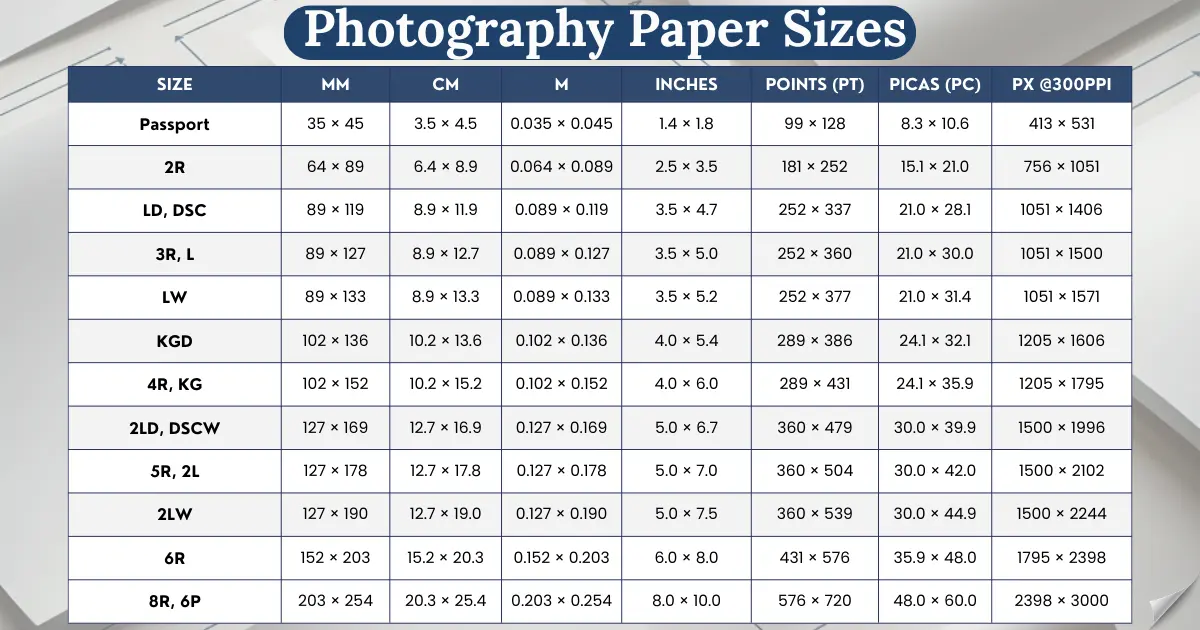
Photo paper sizes range from the tiny Passport (35×45mm) for ID documents, through popular everyday sizes like 4R (4×6 inches), 5R (5×7 inches), and 8R (8×10 inches), up to the professional A3+ Super B (13×19 inches), with Japanese equivalents like L, KG, and 2L matching 3R, 4R, and 5R respectively.
Professionals choose glossy, matte, or lustre finishes on 240–310 GSM premium paper, with resolution needs ranging from 2.2MP for 4R to 22.2MP for A3+ Super B, and costs spanning from $0.09 per 4R print to $50 for large gallery formats.
Complete Photo Paper Sizes Chart
Small Format Photo Sizes (Passport to 3R)
Passport size is the smallest standard photo format used worldwide. At just 35 × 45 mm (1.4 × 1.8 inches), it’s specifically designed for ID cards, visa applications, and official documents.
2R size measures 64 × 89 mm (2.5 × 3.5 inches) and serves as the classic wallet-sized photo. This compact format fits perfectly in wallets, small frames, and photo albums without taking up much space.
LD and DSC sizes are identical at 89 × 119 mm (3.5 × 4.7 inches). These formats match early digital camera screen ratios and work great for quick prints from point-and-shoot cameras.
3R (also called L size) is one of America’s most popular small formats at 89 × 127 mm (3.5 × 5 inches). The Japanese photography industry calls this “L size,” but it’s the same dimension as 3R internationally.
LW size extends the 3R format slightly to 89 × 133 mm (3.5 × 5.2 inches). This wide format option accommodates panoramic shots and wide-screen camera photos without cropping.
Medium Format Photo Sizes (4R to 6R)
KGD size measures 102 × 136 mm (4 × 5.4 inches) and represents the Japanese postcard standard. This format bridges the gap between small prints and standard medium sizes.
4R (also known as KG size) is America’s most commonly printed format at 102 × 152 mm (4 × 6 inches). According to industry data, over 60% of consumer photo prints in the USA are 4×6 photos, making this the most economical choice for everyday memories.
2LD and DSCW sizes measure 127 × 169 mm (5 × 6.7 inches). These wide digital formats match modern digital camera screens and smartphone aspect ratios perfectly.
5R (called 2L in Japan) is the standard 127 × 178 mm (5 × 7 inches) format. This size fits most 5×7 picture frames found in stores and works beautifully for portrait photography.
2LW size extends to 127 × 190 mm (5 × 7.5 inches) for wide-format printing. Professional photographers use this for landscape shots and panoramic compositions.
6R size measures 152 × 203 mm (6 × 8 inches) and offers more display impact. This format works perfectly for detailed portraits and small wall art installations.
Large Format Photo Sizes (8R to A3+ Super B)
8R (also called 6P) is the classic 203 × 254 mm (8 × 10 inches) professional portrait size. Studios have used this format for decades because it provides excellent detail while remaining affordable.
S8R (labeled 6PW) extends to 203 × 305 mm (8 × 12 inches) as a super wide format. This “Super 8R” maintains the 3:2 aspect ratio that matches most DSLR cameras and modern smartphones.
11R size measures 279 × 356 mm (11 × 14 inches) and serves as a statement wall print. This format costs more but delivers impressive visual impact for important photographs.
A3+ Super B is the largest standard format at 330 × 483 mm (13 × 19 inches). Professional photographers and fine art printers favor this size for gallery-quality prints and exhibition work.
Photo Paper Size Comparisons
R-Series Size Progression Explained
The R-series naming system uses numbers to indicate size progression. A higher number means a larger print, making it easy to remember which format you need.
2R is the smallest in the consumer series at 2.5 × 3.5 inches. 3R (L size) steps up to 3.5 × 5 inches, while 4R (KG) measures 4 × 6 inches for everyday printing.
Is 4R or 5R bigger? The answer is clear: 5R is bigger at 5 × 7 inches compared to 4R’s 4 × 6 inches. That’s an extra inch in both width and height, providing 40% more print area.
6R extends further to 6 × 8 inches, and 8R jumps significantly to 8 × 10 inches. The progression follows a logical pattern where each step up adds noticeable display space.
Standard versus Super series differs in aspect ratio. Regular R-sizes follow varying ratios, while Super series (S8R, S6R) maintains the 3:2 ratio that matches DSLR cameras and prevents cropping.
Understanding Japanese Photography Nomenclature
Japan’s photo industry developed its own naming system that differs from international standards. Understanding these equivalents prevents confusion when ordering prints.
L size equals 3R (both are 89 × 127 mm). KG size matches 4R (both are 102 × 152 mm). 2L corresponds to 5R (both measure 127 × 178 mm).
DSC and DSCW indicate digital camera formats. DSC stands for “Digital Still Camera” and matches early digital camera screens. The “W” in DSCW means “Wide” for wide-screen digital formats.
A-Series Sizes Ranked and Compared
The A-series paper system follows a mathematical pattern where each size is exactly half the previous one. This European standard has gained popularity worldwide for photography.
Choosing the Right Photo Print Size for Every Occasion
Passport size serves official documentation. 4R dominates everyday printing. Larger sizes serve portraits and professional needs.
Serves one primary purpose—official documentation. Governments worldwide require this exact dimension for passports, visas, and ID cards.
Work perfectly for wallets, small desk frames, and photo albums. Ideal for keeping loved ones close.
Dominates everyday photo printing. Drugstores price this cheaply because printers optimize for this dimension. Most cost-effective for family memories.
Fits standard frames found in every home goods store. Balances visibility with affordability for home display.
Provides more detail for portraits. The larger area showcases faces better and works well for gift photos.
Professional portrait standard. Studios charge premiums for this format because it delivers impressive detail on walls.
Museums and exhibitions use these large formats to create visual impact and showcase fine details.
Understanding frame compatibility saves money and prevents disappointing results.
| Photo Size | Frame Needed | Mat Required? | Best For |
|---|---|---|---|
| 4R (4×6) | 4×6 or 5×7 | No / Yes | Everyday photos |
| 5R (5×7) | 5×7 or 8×10 | No / Yes | Home display |
| 6R (6×8) | 8×10 | Yes | Portraits |
| 8R (8×10) | 8×10 or 11×14 | No / Yes | Professional |
| 11R (11×14) | 11×14 or 16×20 | No / Yes | Wall art |
Require special frames or custom matting. Standard rectangular frames won’t accommodate these panoramic aspect ratios without cropping your image.
Need European-style frames or custom solutions. A4 measures 8.3 × 11.7 inches, which doesn’t match common American 8×10 or 11×14 frame sizes.
Modern smartphones capture images in 4:3 or 16:9 aspect ratios.
Standard Ratio
DSC & LD: Matches early digital cameras (89 × 119 mm). Works well for point-and-shoot photos without cropping.
Wide Format
DSCW & 2LD: Accommodates newer cameras and phones with wide-screen ratios. Prevents cutting off edges.
iPhone Photos
Typically need cropping for standard sizes. The 4:3 ratio doesn’t fit perfectly into 4×6 or 5×7 frames. Use S8R (8×12) or 2LW (5×7.5) to preserve more image.
Android Devices
Vary widely in camera ratios. Check your phone’s aspect ratio setting—some offer 3:2, 4:3, or 16:9 options before shooting.
Best Photo Sizes by Use Case
Passport size (35 × 45 mm) serves one primary purpose—official documentation. Governments worldwide require this exact dimension for passports, visas, and ID cards.
2R and 3R (L) sizes work perfectly for wallets, small desk frames, and photo albums.
4R (KG) at 4 × 6 inches dominates everyday photo printing. Drugstores and online services price this size cheaply because printers optimize for this dimension, making it the most cost-effective choice for family memories.
5R (2L) at 5 × 7 inches fits standard frames found in every home goods store. This size balances visibility with affordability for home display purposes.
6R prints at 6 × 8 inches provide more detail for portraits and important photographs. The larger area showcases faces better and works well for gift photos.
8R (6P) at 8 × 10 inches remains the professional portrait standard. Photography studios charge premium prices for this format because it delivers impressive detail and looks professional on any wall.
11R and A3+ Super B serve gallery-quality printing needs. Museums, exhibitions, and professional portfolios use these large formats to create visual impact and showcase fine details.
Matching Photo Sizes to Frame Dimensions
Understanding frame compatibility saves money and prevents disappointing results. Not every photo size matches standard frame dimensions without modification.
4R photos (4 × 6 inches) fit 4×6 frames perfectly without matting. However, placing a 4×6 print in a 5×7 frame requires a mat board to fill the gap and center the image.
5R prints (5 × 7 inches) match 5×7 frames exactly, making them convenient for home display. This size dominates retail frame selections across America.
8R photos (8 × 10 inches) work in 8×10 frames without adjustment. Craft stores stock these frames abundantly because photographers order this size frequently.
Wide formats (LW, 2LW, DSCW, S8R) require special frames or custom matting. Standard rectangular frames won’t accommodate these panoramic aspect ratios without cropping your image.
A-series prints need European-style frames or custom solutions. A4 measures 8.3 × 11.7 inches, which doesn’t match common 8×10 or 11×14 American frame sizes.
Digital Camera and Smartphone Photo Sizes
Modern smartphones capture images in 4:3 or 16:9 aspect ratios that don’t match traditional photo paper dimensions. Understanding this prevents unwanted cropping.
DSC and LD formats (89 × 119 mm) match early digital cameras with 4:3 screens. These sizes work well for point-and-shoot camera photos without cropping.
DSCW and 2LD wide formats (127 × 169 mm) accommodate newer cameras and phones with wide-screen ratios. These prevent cutting off edges when printing smartphone photos.
iPhone photos typically need cropping for standard sizes. The 4:3 ratio doesn’t fit perfectly into 4×6 or 5×7 frames. S8R (8×12) or 2LW (5×7.5) preserve more of your image.
Android devices vary widely in camera ratios. Check your phone’s aspect ratio setting—some offer 3:2 (DSLR-like), 4:3 (standard), or 16:9 (wide) options before shooting.
FAQ’s (Photo Paper Sizes)
What are the standard sizes of photo paper?
The most common standard photo sizes in America are 4×6 inches (4R), 5×7 inches (5R), and 8×10 inches (8R). These three formats account for over 85% of consumer photo printing. Other standard sizes include 3R (3.5×5), 6R (6×8), 11R (11×14), and A3+ Super B (13×19) for professional work.
Is 4R or 5R bigger?
5R is bigger than 4R. A 4R photo measures 102 × 152 mm (4 × 6 inches) while 5R measures 127 × 178 mm (5 × 7 inches).
What are common photograph sizes?
The most common photograph sizes are 4×6 inches (4R/KG), 5×7 inches (5R/2L), and 8×10 inches (8R/6P). Drugstores and online services optimize their pricing for these dimensions. Wallet size (2R at 2.5×3.5 inches) remains popular for sharing, while 11×14 inches (11R) serves wall art purposes.
What kind of paper do professional photographers use?
Professional photographers typically use premium branded paper from Epson, Canon, Hahnemühle, or Ilford. They prefer lustre (semi-gloss) finish for portraits, matte finish for fine art, and glossy finish for vibrant color work. Paper weight ranges from 240-310 GSM, with heavier weights feeling more premium and durable.
What’s the difference between 3R and L size?
3R and L size are identical—both measure 89 × 127 mm (3.5 × 5 inches). The difference is purely naming convention. “3R” follows the international R-series system while “L” represents the Japanese photography standard.
When should I use wide format sizes like LW, 2LW, or S8R?
Use wide format sizes (LW, 2LW, DSCW, S8R, 6PW) when printing panoramic photos or images from wide-screen cameras. These formats maintain the 3:2 or 16:9 aspect ratio without cropping your composition. They’re perfect for landscape photography, group shots, and smartphone photos that would lose important details in standard sizes.
What size is KG in American measurements?
KG equals 4 × 6 inches in American measurements. This Japanese format name matches the internationally recognized 4R size exactly. KG measures 102 × 152 mm, making it America’s most popular and economical photo print size for everyday use.
Conclusion
Choosing the right photo paper size transforms your printing experience from frustrating to professional. Understanding dimensions from Passport (35 × 45 mm) through A3+ Super B (330 × 483 mm) empowers you to make informed decisions.
The 4R (4×6 inch) size dominates consumer printing for good reason—it’s affordable, frames easily, and handles everyday memories perfectly. When you need more impact, 5R (5×7 inches) and 8R (8×10 inches) deliver professional results without breaking your budget.
Match your paper choice to your final use, check your image resolution requirements, and select quality paper that showcases your photographs beautifully.

Hi, I’m Steven Henry, the creator behind Papersizechart.com. My goal is to make measurements easy for everyone, from paper sizes to everyday dimensions. I help you find the right paper for printing, crafts, or school projects and understand the measurements you need for your space or projects—all without the confusion. Let’s explore guides and charts together, so you can work with paper and dimensions confidently for any task.