German paper sizes use the DIN 476 standard with four series: A (everyday use, A4 at 210×297mm), B (books), C (envelopes), and D (historical D0-D8). Each size is exactly half the previous one, following a √2 ratio from A0’s one square meter base.
This ISO 216 system differs from US Letter/Legal and is used in 100+ countries. This guide covers all dimensions in mm, cm, inches, pt, pc, px @300ppi, plus US comparisons, scaling percentages, printer setup, and where Americans can buy German paper formats.
Complete German Paper Sizes Chart: A, B, C & D Series Dimensions
DIN A Series – Most Common Formats
The A series handles 95% of paper needs in Germany. A4 is the universal office standard, equivalent to what US Letter does in America.
Complete DIN A Sizes:
Practical uses: A4 dominates office documents and correspondence. A3 works for posters, technical drawings, and newspapers. A5 fits notepads and small brochures. A6 serves as postcard size.
DIN B Series – Intermediate Specialized Sizes
The B series sits between A sizes. B5 measures larger than A5 but smaller than A4. These formats solve printing problems when A sizes don’t quite fit.
Complete DIN B Sizes:
Common applications: B5 is popular for books, especially technical manuals and textbooks. German passports use B7 format. B4 works for oversized documents that exceed A4 but don’t need full A3.
DIN C Series – Envelope Standards
The C series exists specifically for envelopes. The genius: a C4 envelope perfectly fits an unfolded A4 sheet with minimal extra space.
Complete DIN C Sizes:
Envelope matching: C4 fits A4 flat. C5 fits A4 folded once. C6 fits A4 folded twice. This system eliminates guessing which envelope fits which document.
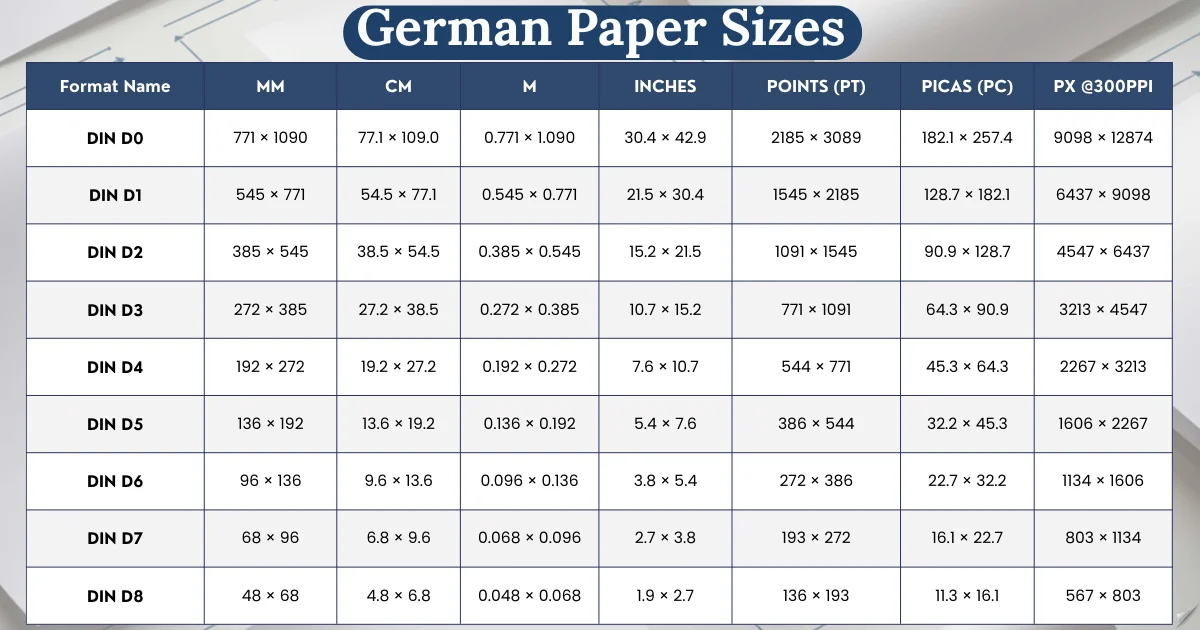
DIN D Series – Historical & Rare Formats
The D series appeared in the original 1922 and 1925 DIN 476 editions. Though officially withdrawn in later versions, these sizes still surface in archival work and specialized printing.
Complete DIN D Sizes:
When D sizes appear: Historical archives, vintage printing specifications, and certain engineering documents from the early-to-mid 20th century.
Modern printers rarely support D formats, but understanding them helps when digitizing old German technical drawings.
German vs US Paper Sizes
German vs US Paper Sizes
German and US paper sizes operate on completely different systems. This creates headaches for Americans working with European partners.
| German Format | Dimensions (mm) | Closest US Size | US Dimensions (mm) | Difference |
|---|---|---|---|---|
| A4 | 210 × 297 | Letter | 216 × 279 | A4 is narrower, taller |
| A3 | 297 × 420 | Ledger/Tabloid | 279 × 432 | A3 is wider, shorter |
| A5 | 148 × 210 | Statement | 140 × 216 | Similar but not exact |
| — | — | Legal | 216 × 356 | No A equivalent |
When you print US content on A4 paper, margins get weird. Text doesn’t scale evenly. Headers and footers shift position.
Despite being narrower, A4 offers 6% more area than Letter.
No B or D Equivalent Exists
No B or D equivalent exists in US standards. When German partners send B5 specifications, Americans struggle to find matching paper. Most US office printers don’t stock B or D sizes.
German and US paper sizes operate on completely different systems. This creates headaches for Americans working with European partners.
Direct Size Comparison:
The fundamental difference: US sizes use arbitrary dimensions based on inches. German DIN formats follow the √2 ratio, making every size mathematically proportional.
Surface area matters. A4 provides 62,370 mm² of space. US Letter gives 60,129 mm². Despite being narrower, A4 offers 6% more area than Letter.
Aspect ratio confusion: US Letter has a 1:1.294 ratio. A4 maintains 1:1.414. When you print US content on A4 paper, margins get weird. Text doesn’t scale evenly. Headers and footers shift position.
No B or D equivalent exists in US standards. When German partners send B5 specifications, Americans struggle to find matching paper. Most US office printers don’t stock B or D sizes.
FAQ’s (German Paper Size)
What is the standard paper size in Germany?
A4 (210 × 297 mm or 8.3 × 11.7 inches) is the standard paper size in Germany. It’s used for all office documents, letters, forms, and everyday printing—equivalent to what US Letter does in America but with different dimensions.
Is DIN A4 the same as A4?
Yes, DIN A4 and A4 are exactly the same. “DIN” stands for Deutsches Institut für Normung (German Institute for Standardization), which created the original standard. The format is now internationally recognized as ISO 216 A4, but both terms refer to the identical 210 × 297 mm size.
What is the German paper format?
The German paper format is the DIN system with four series: A series (trimmed paper for documents), B series (intermediate sizes for books), C series (envelopes), and D series (historical formats). All follow a √2 aspect ratio where each size is exactly half the previous one, starting from A0 at one square meter.
Conclusion
German paper sizes follow the DIN system, which is now the international standard used by most countries worldwide. A4 is the most common size, similar to US Letter but with slightly different dimensions that can cause printing problems if you’re not careful.
The main thingUS professionals need to remember is that A4 (210 × 297 mm) is narrower but taller than Letter (8.5 × 11 inches). Always check which paper size a document uses before printing, especially when working with European clients or partners.
Save this guide and refer back to it whenever you work on international projects. Knowing these paper sizes will help you avoid mistakes, save money on reprinting, and look more professional when doing business with European companies.

Hi, I’m Steven Henry, the creator behind Papersizechart.com. My goal is to make measurements easy for everyone, from paper sizes to everyday dimensions. I help you find the right paper for printing, crafts, or school projects and understand the measurements you need for your space or projects—all without the confusion. Let’s explore guides and charts together, so you can work with paper and dimensions confidently for any task.