Chinese paper sizes are built on their own national system — completely separate from US or ISO formats. If you print, design, or publish anything for China, this guide is your essential reference.
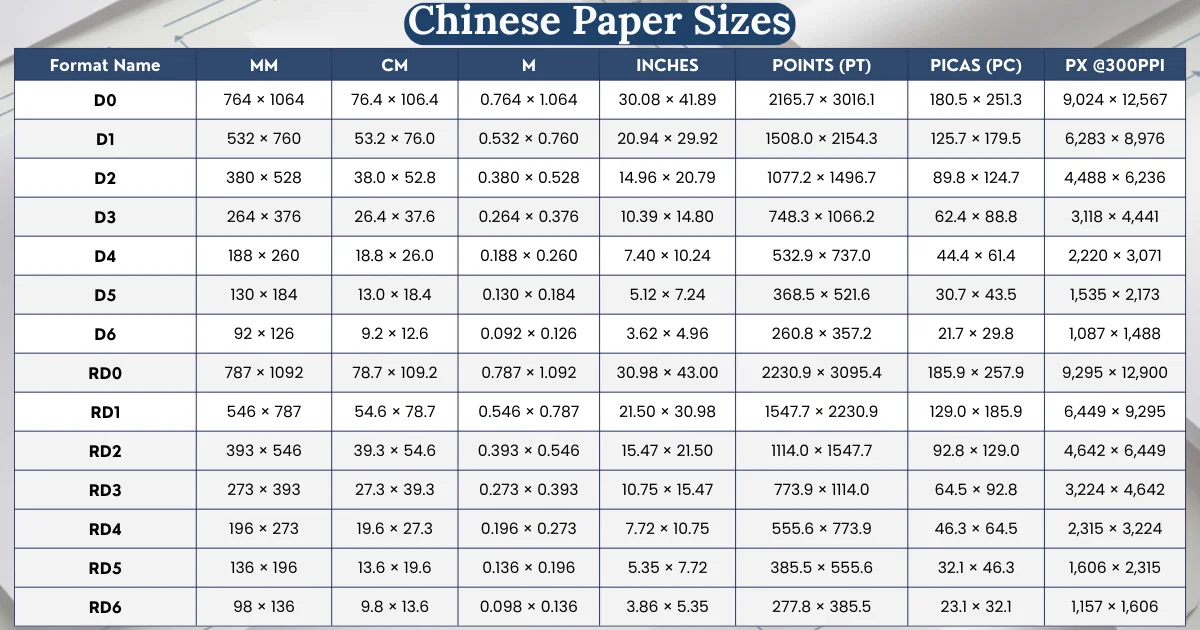
In this guide we cover all 14 official sizes — D0 through D6 and RD0 through RD6 — in mm, cm, m, inches, pt, pc, and px @300ppi.
What Are Chinese Paper Sizes?
Chinese paper sizes are defined by the GB/T 148-1997 standard — China’s official national paper size regulation. This standard is independent from ISO 216 and follows its own scaling logic.
China’s format system dates back to the Republic of China era (1912–1949), making it one of the oldest surviving regional paper standards in the world.
The GB/T 148-1997 Standard
The GB/T 148-1997 defines two parallel series — the trimmed D series and the untrimmed RD series. Both are mandatory references for Chinese commercial printing.
This standard does not derive from an A0 base like ISO 216. It uses entirely different base dimensions.
How the √2 Aspect Ratio Works in Chinese Sizes
Every Chinese D series size carries an aspect ratio of approximately √2 (1:1.414). The long side of each size is exactly twice the short side of the next smaller size.
This is the same mathematical principle as ISO — but applied to different base measurements, producing physically distinct dimensions.
Chinese D Series vs. Swedish D Series
The Swedish D series and Chinese D series share a name — nothing else. They have completely different origins, dimensions, and applications.
Never reference Swedish D sizing when working on Chinese print production. The confusion has caused real-world printing errors in cross-border projects.
Complete Chinese Paper Size Chart
This is the only reference table you need. All 14 Chinese paper sizes — every unit included Mm. Cm, M, Inches, Pt. Pc, px @300ppi:
D Series Paper Sizes — D0 to D6 Explained
The D series is the trimmed, finished side of Chinese paper sizing. These are the final cut dimensions your printed piece will actually be.
Each size from D0 down to D6 is exactly half the area of the size above it — a clean, scalable system built for efficient press imposition.
D0 — Largest Chinese Paper Size
D0 measures 764 × 1064 mm — the largest format in the entire Chinese D series. It is used for large-format posters, architectural drawings, and oversized commercial print runs.
At 9,024 × 12,567 px @300ppi, D0 delivers extreme resolution capacity for high-detail large-scale print work.
D1 — Large Publishing & Newspaper Format
D1 is 532 × 760 mm — exactly half of D0. It is the dominant format for Chinese newspaper layouts, editorial spreads, and large-run brochure production.
At 20.94 × 29.92 inches, D1 sits close to a US Broadsheet newspaper in physical scale — but they are not interchangeable.
D2 — Mid-Format Commercial Print Size
D2 measures 380 × 528 mm. It is a workhorse size in Chinese commercial printing — used for folded newspapers, large promotional flyers, and art edition prints.
In typographic points, D2 runs 1077.2 × 1496.7 pt — a critical reference when setting up professional design software document presets.
D3 — Catalog, Book & Presentation Format
D3 is 264 × 376 mm — a natural fit for product catalogs, corporate presentation folders, and medium-format book production across China.
At 10.39 × 14.80 inches, D3 sits between US Letter and Tabloid — but matches neither. Always use exact D3 dimensions in your document setup.
D4 — Most Used Chinese Office Paper Size
D4 at 188 × 260 mm is the most widely used paper size in China for everyday office printing and domestic publishing. It is China’s functional equivalent of the US Letter.
D4 is smaller than US Letter (8.5 × 11 in = 215.9 × 279.4 mm) — do not swap layouts between the two without resizing your document.
D5 — Small Format for Booklets & Notepads
D5 measures 130 × 184 mm. It is used across China for compact booklets, pocket-sized directories, small-run notepads, and product inserts.
At 1,535 × 2,173 px @300ppi, D5 still delivers sharp print-resolution output for detailed small-format design work.
D6 — Smallest D Series Format
D6 is 92 × 126 mm — the smallest size in the entire Chinese paper size system. It is used for business cards, hang tags, small leaflets, and compact promotional pieces.
At just 3.62 × 4.96 inches, D6 is a precise, compact format that requires tight margin and bleed discipline in file preparation.
RD Series Paper Sizes — RD0 to RD6 Explained
The RD series is the raw, untrimmed counterpart to the D series. These are the press sheets — always slightly larger than the matching D size.
Every RD size includes space for bleed allowance, gripper margin, and trim marks — the three essentials of professional offset press production.
RD0 — Raw Base Sheet for Large Press Runs
RD0 is 787 × 1092 mm — the untrimmed sheet that gets cut down to D0 (764 × 1064 mm) after printing. It is the foundation sheet for large-format commercial offset printing in China.
At 30.98 × 43.00 inches, RD0 is one of the largest standard press sheets used in the Chinese printing industry.
RD1 — Newspaper & Broadsheet Raw Sheet
RD1 measures 546 × 787 mm. It is the raw press sheet trimmed to produce D1 — standard across Chinese newspaper presses and high-volume publishing runs.
At 6,449 × 9,295 px @300ppi, RD1 provides the pixel real estate needed for full-bleed large-format print file setup.
RD2 — Standard Commercial Offset Press Sheet
RD2 is 393 × 546 mm — one of the most common raw sheets across Chinese commercial offset printing facilities. It trims down to the finished D2 size.
In picas, RD2 runs 92.8 × 129.0 pc — a useful reference when working in publishing layout software with pica-based grids.
RD3 — Book Production Raw Sheet
RD3 measures 273 × 393 mm. It is the standard raw sheet for D3 book, catalog, and bound-document production in Chinese print facilities.
At 10.75 × 15.47 inches, RD3 gives press operators the trim margin they need for clean, accurate final D3 cuts.
RD4 — Most Used Raw Sheet in China
RD4 at 196 × 273 mm is the single most used raw press sheet across all Chinese printing facilities. It is the untrimmed version of D4 — China’s most popular finished sheet size.
Every professional Chinese print-ready file destined for D4 output should be built against RD4 dimensions with 3mm bleed on all sides.
RD5 — Small Format Raw Press Sheet
RD5 measures 136 × 196 mm. It is the raw sheet trimmed down to produce finished D5 booklets, card stock pieces, and compact commercial print formats.
At 385.5 × 555.6 pt, RD5 is a precise small-format sheet that demands accurate trim and registration marks in press file setup.
RD6 — Smallest Raw Chinese Paper Size
RD6 is 98 × 136 mm — the smallest raw sheet in the Chinese paper size standard. It produces the finished D6 format after trimming.
At 1,157 × 1,606 px @300ppi, RD6 is compact but fully capable of delivering sharp 300 dpi print resolution for tags, cards, and small-format pieces.
D Series vs. RD Series — What Is the Real Difference?
D sizes are finished and trimmed. RD sizes are raw and uncut. Every RD sheet is slightly larger than its matching D sheet.
The RD series exists specifically to absorb bleed, gripper, and trim. Always design to D dimensions — always send RD-sized press sheets to the printer.
Chinese Paper Sizes vs. US, A Series & International Standards
This is the section most competing blogs skip entirely — and it is the most practically valuable part for any US-based reader.
Chinese Paper Sizes vs. US Letter, Legal & Tabloid
D4 (188 × 260 mm) is the closest Chinese equivalent to US Letter (215.9 × 279.4 mm) — but it is noticeably narrower and shorter. They cannot substitute each other.
Never substitute a Chinese D size for a US standard size without rebuilding your layout from scratch.
Chinese Paper Sizes vs. ISO A Series
Every Chinese D size is smaller than its corresponding ISO A size. Sending an A4 layout to a D4 Chinese printer without resizing will result in cropped content.
The GB/T 148-1997 D series is consistently smaller than ISO 216 A series at every equivalent level.
Chinese Paper Sizes vs. B Series
ISO B5 is 176 × 250 mm — smaller than both A4 (210 × 297 mm) and D4 (188 × 260 mm). So A4 is bigger than B5.
ISO B3 measures 353 × 500 mm — larger than A4 but smaller than A3. B3 is definitively bigger than A4 and sits between A3 and A2 in the size hierarchy.
16K Paper — China’s Hidden Everyday Format
16K (195 × 270 mm) is a traditional Chinese paper format used heavily in schools, government offices, and domestic textbook printing across China.
16K is smaller than A4 (210 × 297 mm) but larger than D4 (188 × 260 mm). It is practically invisible outside China — yet it is one of the most printed formats inside the country.
Working With Chinese Paper Sizes in the USA
Working With Chinese Sizes in the USA
Practical workflow adjustments for US designers and print buyers handling D Series formats.
US Printer Setup
US printers default to Letter/Tabloid and do not recognize D sizes natively.
Software Configuration
Enter exact dimensions manually in document setup.
- InDesign: File > Document Setup
- Illustrator: Custom Artboard Size
- Photoshop: Canvas Size (mm @ 300ppi)
Bleed & Margins
Add 3mm bleed on all sides to match RD series raw sheet requirements.
Vendor Communication
US vendors rarely stock D series standardly.
- Specify Custom Size in mm & inches.
- Reference GB/T 148-1997 standard.
- Confirm specs in writing before press.
Critical: Never assume a US vendor understands “D Size.” Always provide exact written dimensions to prevent expensive reprints.
US designers and print buyers face real friction when working with Chinese paper formats. Here is how to eliminate it.
Can You Print Chinese Paper Sizes on US Printers?
Yes — but only through custom paper size configuration. US printers default to Letter, Legal, or Tabloid. None match D series dimensions.
Go to your printer driver settings, select “Custom Paper Size,” and enter the exact mm or inch dimensions from the master table above. For D4, that is 188 × 260 mm or 7.40 × 10.24 inches.
Setting Up Chinese Paper Sizes in Adobe Software
In Adobe InDesign, go to File → Document Setup → enter custom W × H in mm. Use exact D series values from this guide.
In Adobe Illustrator, create a new document → select Custom artboard size → enter dimensions. In Photoshop, set canvas size manually in mm at 300 ppi for full print-resolution output.
Bleed & Margin Setup for Chinese Paper Sizes
Always add 3mm bleed on all four sides for any Chinese commercial print job. This is the exact function the RD series was designed to support.
For a D4 press-ready file, your total document with bleed should be 194 × 266 mm — closely matching the RD4 raw sheet (196 × 273 mm) footprint.
Ordering Chinese Paper Sizes from US Print Vendors
Most US print shops do not carry D series paper as a standard stock. You must specify it as a custom size — provide dimensions in both mm and inches to avoid miscommunication.
Always confirm your vendor understands GB/T 148-1997 sizing — not ISO A series. Put exact dimensions in writing before any job goes to press.
FAQ’s (Chinese Paper Sizes)
What size paper does China use?
China uses paper sizes defined by the GB/T 148-1997 standard — specifically the D series (D0–D6) and RD series (RD0–RD6). The most common daily-use size is D4 (188 × 260 mm).
China also uses 16K (195 × 270 mm) in schools and government, and A4 in international business contexts.
Which is bigger, 16K or A4?
A4 is bigger than 16K. A4 is 210 × 297 mm while Chinese 16K is approximately 195 × 270 mm. A4 is wider and taller than 16K.
What is the US China white paper?
The US-China white paper is a government policy document — not a paper size. It refers to official policy reports on trade, diplomacy, or bilateral relations between the US and China. It has zero connection to Chinese paper size standards or printing formats.
What is the 0.1% rule in China?
The 0.1% rule means that even capturing just 0.1% of China’s massive market can generate enormous revenue for any business. It reflects why global companies view China’s 1.4 billion population as an unmatched commercial opportunity.
What are the three forbidden Ts in China?
The three forbidden Ts are Taiwan, Tibet, and Tiananmen — three politically sensitive topics strictly avoided in public discussion, media, and business in China. Mentioning them openly can result in serious legal, social, or professional consequences.
What is the traditional paper in China?
Xuan paper (宣纸), also called Rice paper, is China’s most celebrated traditional paper — handcrafted in Anhui Province for over 1,500 years. It is famously used for Chinese calligraphy, ink painting, and historical document preservation.
Conclusion
Chinese paper sizes run on a completely independent system — governed by GB/T 148-1997 and built around the D series and RD series.
From D0 (764 × 1064 mm) down to RD6 (98 × 136 mm), every size has a precise purpose, a precise dimension, and a precise role in Chinese commercial printing. Use this guide — and the master size table — as your permanent cross-border reference.

Hi, I’m Steven Henry, the creator behind Papersizechart.com. My goal is to make measurements easy for everyone, from paper sizes to everyday dimensions. I help you find the right paper for printing, crafts, or school projects and understand the measurements you need for your space or projects—all without the confusion. Let’s explore guides and charts together, so you can work with paper and dimensions confidently for any task.