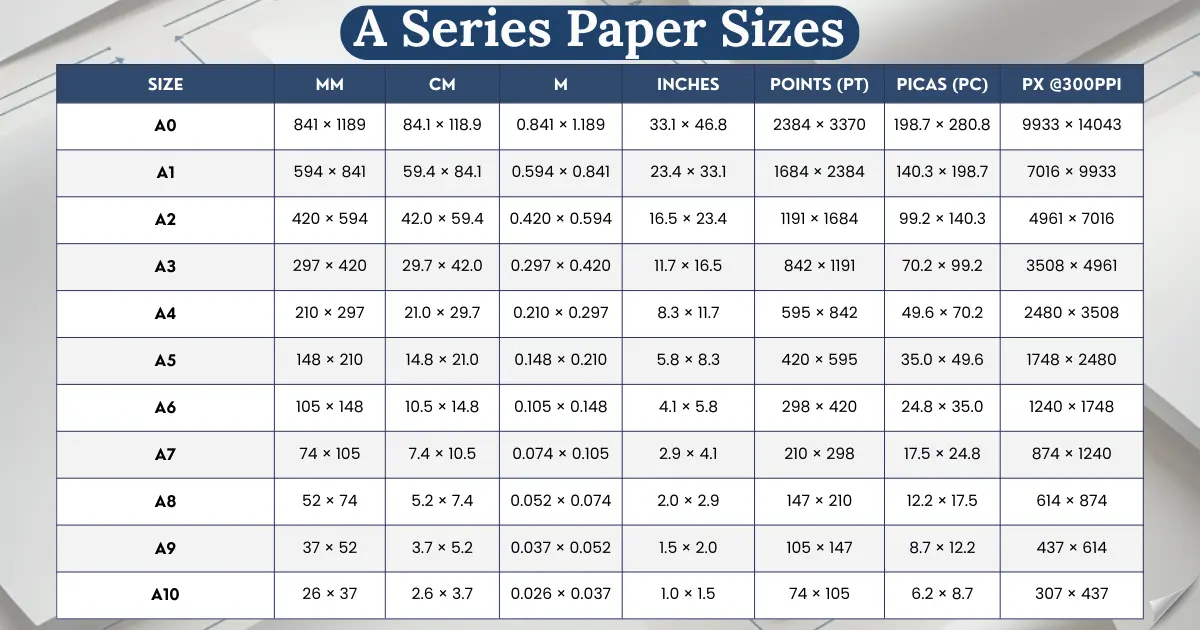
The A series paper sizes follow the ISO 216 international standard used in over 80 countries worldwide. This metric-based system ranges from massive 4A0 formats down to tiny A13 sizes, all maintaining a consistent √2 aspect ratio that makes scaling and folding perfectly proportional.
We covers standard, extended, and oversized formats with exact measurements in millimeters (mm), centimeters (cm), meters (m), inches (in), points (pt), picas (pc), and pixels at 300 PPI.
What is A Series Paper Size?
International paper sizing system uses a mathematical principle where each size maintains a 1:1.4142 aspect ratio (the square root of 2).
The √2 ratio ensures that when you enlarge or reduce documents, the proportions stay identical. Professional printers and designers worldwide rely on this predictability for consistent results across different paper sizes.
US Letter (8.5 × 11 inches) and Legal (8.5 × 14 inches) formats used in America, A series dimensions follow metric measurements. The base size A0 equals exactly one square meter in area (0.999949 m² to be precise).
A Series Paper Sizes Chart – All Dimensions
A series paper dimensions chart with measurements in mm, cm, m, inches, points, picas, and pixels at 300 PPI:
| Size | mm | cm | m | inches | points (pt) | picas (pc) | px@300PPI |
| A0 | 841 × 1189 | 84.1 × 118.9 | 0.841 × 1.189 | 33.1 × 46.8 | 2384 × 3370 | 198.7 × 280.8 | 9933 × 14043 |
| A1 | 594 × 841 | 59.4 × 84.1 | 0.594 × 0.841 | 23.4 × 33.1 | 1684 × 2384 | 140.3 × 198.7 | 7016 × 9933 |
| A2 | 420 × 594 | 42.0 × 59.4 | 0.420 × 0.594 | 16.5 × 23.4 | 1191 × 1684 | 99.2 × 140.3 | 4961 × 7016 |
| A3 | 297 × 420 | 29.7 × 42.0 | 0.297 × 0.420 | 11.7 × 16.5 | 842 × 1191 | 70.2 × 99.2 | 3508 × 4961 |
| A4 | 210 × 297 | 21.0 × 29.7 | 0.210 × 0.297 | 8.3 × 11.7 | 595 × 842 | 49.6 × 70.2 | 2480 × 3508 |
| A5 | 148 × 210 | 14.8 × 21.0 | 0.148 × 0.210 | 5.8 × 8.3 | 420 × 595 | 35.0 × 49.6 | 1748 × 2480 |
| A6 | 105 × 148 | 10.5 × 14.8 | 0.105 × 0.148 | 4.1 × 5.8 | 298 × 420 | 24.8 × 35.0 | 1240 × 1748 |
| A7 | 74 × 105 | 7.4 × 10.5 | 0.074 × 0.105 | 2.9 × 4.1 | 210 × 298 | 17.5 × 24.8 | 874 × 1240 |
| A8 | 52 × 74 | 5.2 × 7.4 | 0.052 × 0.074 | 2.0 × 2.9 | 147 × 210 | 12.2 × 17.5 | 614 × 874 |
| A9 | 37 × 52 | 3.7 × 5.2 | 0.037 × 0.052 | 1.5 × 2.0 | 105 × 147 | 8.7 × 12.2 | 437 × 614 |
| A10 | 26 × 37 | 2.6 × 3.7 | 0.026 × 0.037 | 1.0 × 1.5 | 74 × 105 | 6.2 × 8.7 | 307 × 437 |
| A11 | 18 × 26 | 1.8 × 2.6 | 0.018 × 0.026 | 0.7 × 1.0 | 51 × 74 | 4.2 × 6.2 | 213 × 307 |
| A12 | 13 × 18 | 1.3 × 1.8 | 0.013 × 0.018 | 0.5 × 0.7 | 37 × 51 | 3.1 × 4.2 | 153 × 213 |
| A13 | 9 × 13 | 0.9 × 1.3 | 0.009 × 0.013 | 0.4 × 0.5 | 26 × 37 | 2.2 × 3.1 | 107 × 153 |
A4 paper is the most commonly used size worldwide, roughly equivalent to US Letter but slightly narrower and taller. Standard 80gsm paper weighs 5 grams per A4 sheet and 80 grams per square meter.
Digital designers benefit from pixel dimensions at 300 PPI (pixels per inch) for print-ready artwork. Points (pt) and picas (pc) serve typographers and layout professionals using publishing software like Adobe InDesign.
Oversized A Formats
Extended formats provide larger options beyond standard A0 for specialized industrial and professional applications.
| Size | mm | cm | m | inches | points (pt) | picas (pc) | px@300PPI | vs A0 |
| 4A0 | 1682 × 2378 | 168.2 × 237.8 | 1.682 × 2.378 | 66.2 × 93.6 | 4768 × 6741 | 397.3 × 561.7 | 19866 × 28087 | 4× area |
| 2A0 | 1189 × 1682 | 118.9 × 168.2 | 1.189 × 1.682 | 46.8 × 66.2 | 3370 × 4768 | 280.8 × 397.3 | 14043 × 19866 | 2× area |
| A0+ | 914 × 1292 | 91.4 × 129.2 | 0.914 × 1.292 | 36.0 × 50.9 | 2592 × 3662 | 216.0 × 305.2 | 10800 × 15250 | Oversized |
| A1+ | 609 × 914 | 60.9 × 91.4 | 0.609 × 0.914 | 24.0 × 36.0 | 1728 × 2592 | 144.0 × 216.0 | 7200 × 10800 | Oversized |
| A3+ | 329 × 483 | 32.9 × 48.3 | 0.329 × 0.483 | 13.0 × 19.0 | 936 × 1368 | 78.0 × 114.0 | 3900 × 5700 | Oversized |
4A0 and 2A0 follow the same √2 ratio principle but aren’t widely standardized. The “plus” sizes (A0+, A1+, A3+) vary slightly by manufacturer but typically add 10-15% to standard dimensions for printing with trim margins.
Professional photo labs commonly use A3+ paper (also called Super B or 13×19 inches) for prints with bleeds. This allows photographers to print full-frame images without white borders.
Conversion reference: 1 inch = 25.4 mm = 72 points = 6 picas. 1 point = 0.3528 mm. 1 pica = 4.233 mm. 300 PPI means 300 pixels per inch for high-resolution print output.
A Series Size Comparison
*Each subsequent size is half the area of the previous.
The mathematical relationship stays consistent throughout the entire A series.
Oversized and Large Format Hierarchy
4A0 is the largest A format at 1682 × 2378 mm (1.682 × 2.378 m or 66.2 × 93.6 inches), roughly the size of a king-size bed sheet. This massive format measures 4768 × 6741 points or 397.3 × 561.7 picas.
2A0 doubles the area of A0, measuring 1189 × 1682 mm (1.189 × 1.682 m or 46.8 × 66.2 inches). At 3370 × 4768 points, engineers use it for master construction drawings requiring extreme detail.
A0+ provides extra margin beyond standard A0, typically around 914 × 1292 mm (0.914 × 1.292 m or 36.0 × 50.9 inches). Digital files need 10800 × 15250 pixels at 300 PPI for print-ready artwork.
A0 itself measures 841 × 1189 mm (84.1 × 118.9 cm or 0.841 × 1.189 m), about the size of a standard door. Technical drafters work with 2384 × 3370 points or 198.7 × 280.8 picas in design software.
A1+ oversized format measures approximately 609 × 914 mm (60.9 × 91.4 cm or 24.0 × 36.0 inches). Designers need 7200 × 10800 pixels for 300 PPI output.
A1 is exactly half of A0 at 594 × 841 mm (59.4 × 84.1 cm or 23.4 × 33.1 inches). Layout professionals work with 1684 × 2384 points or 140.3 × 198.7 picas.
Medium Format Comparisons
A2 measures 420 × 594 mm (42.0 × 59.4 cm or 16.5 × 23.4 inches), ideal for restaurant menus and small posters. Digital dimensions reach 4961 × 7016 pixels at 300 PPI.
A3+ provides printing flexibility at approximately 329 × 483 mm (32.9 × 48.3 cm or 13.0 × 19.0 inches). Photo labs require 3900 × 5700 pixel files for optimal print quality.
A3 is twice the size of A4 at 297 × 420 mm (29.7 × 42.0 cm or 11.7 × 16.5 inches). Typographers work with 842 × 1191 points or 70.2 × 99.2 picas.
A4 serves as the universal document standard at 210 × 297 mm (21.0 × 29.7 cm or 8.3 × 11.7 inches). Digital documents need 2480 × 3508 pixels for 300 PPI printing, with 595 × 842 points in layout software.
A5 is half of A4, measuring 148 × 210 mm (14.8 × 21.0 cm or 5.8 × 8.3 inches). Design files require 1748 × 2480 pixels at 300 PPI with 420 × 595 points for publishing.
A6 matches standard postcard size at 105 × 148 mm (10.5 × 14.8 cm or 4.1 × 5.8 inches). Digital artwork needs 1240 × 1748 pixels for print-ready output.
Compact and Micro Format Scale
A7 through A10 serve specialized purposes. A7 (74 × 105 mm or 7.4 × 10.5 cm) measures 2.9 × 4.1 inches with 874 × 1240 pixels at 300 PPI.
A8 (52 × 74 mm or 5.2 × 7.4 cm) equals 2.0 × 2.9 inches, requiring 614 × 874 pixels for digital printing. Typographers use 147 × 210 points.
A9 measures 37 × 52 mm (3.7 × 5.2 cm or 1.5 × 2.0 inches), approaching business card territory. Files need 437 × 614 pixels at 300 PPI.
A10 is stamp-sized at 26 × 37 mm (2.6 × 3.7 cm or 1.0 × 1.5 inches). Digital designers work with 307 × 437 pixels or 74 × 105 points.
A11, A12, and A13 represent micro formats rarely seen in everyday use. A11 (18 × 26 mm), A12 (13 × 18 mm), and A13 (9 × 13 mm) measure 0.018 × 0.026 m, 0.013 × 0.018 m, and 0.009 × 0.013 m respectively.
To answer common size comparison questions: A1 is twice as large as A2. A5 is double the size of A6. A4 is four times bigger than A6. The mathematical relationship stays consistent throughout the entire A series paper size chart.
Common Uses for Each A Series Paper Size
Industrial and Oversized Applications
4A0 and 2A0 serve industrial needs like construction master plans measuring 1682 × 2378 mm and 1189 × 1682 mm respectively. Manufacturing facilities use these formats for quality control documentation requiring 19866 × 28087 pixels and 14043 × 19866 pixels at 300 PPI.
A0+ and A1+ formats benefit professional photographers and fine art printers who need extra space for trimming. Gallery prints at 914 × 1292 mm (36.0 × 50.9 inches) require 10800 × 15250 pixel files.
A0 paper handles technical drawings at 841 × 1189 mm (84.1 × 118.9 cm). Architects work with 2384 × 3370 point documents, while digital files need 9933 × 14043 pixels for precision printing.
A1 dimensions suit poster printing at 594 × 841 mm (59.4 × 84.1 cm or 23.4 × 33.1 inches). Design software uses 1684 × 2384 points, requiring 7016 × 9933 pixels at 300 PPI.
Professional and Business Formats
A2 paper works perfectly at 420 × 594 mm (42.0 × 59.4 cm) for restaurant menus and promotional materials. Digital files need 4961 × 7016 pixels with 1191 × 1684 point layouts.
A3+ serves photo labs at approximately 329 × 483 mm (13.0 × 19.0 inches), requiring 3900 × 5700 pixel files for professional-quality prints with proper bleeds.
A3 dimensions fit marketing brochures at 297 × 420 mm (29.7 × 42.0 cm). Designers work with 842 × 1191 points or 70.2 × 99.2 picas, needing 3508 × 4961 pixels at 300 PPI.
A4 remains the global standard at 210 × 297 mm (21.0 × 29.7 cm or 8.3 × 11.7 inches). Digital documents use 595 × 842 points with 2480 × 3508 pixel dimensions for print-ready files.
A5 size accommodates notebooks at 148 × 210 mm (14.8 × 21.0 cm). Publishers work with 420 × 595 points or 35.0 × 49.6 picas, requiring 1748 × 2480 pixels for digital printing.
Consumer and Compact Applications
A6 paper matches international postcard standards at 105 × 148 mm (10.5 × 14.8 cm or 4.1 × 5.8 inches). Digital artwork needs 1240 × 1748 pixels with 298 × 420 point layouts.
A7 format suits wallet-sized photographs at 74 × 105 mm (7.4 × 10.5 cm). Files require 874 × 1240 pixels at 300 PPI or 210 × 298 points for typesetting.
A8 dimensions match playing cards at 52 × 74 mm (5.2 × 7.4 cm or 2.0 × 2.9 inches). Design files use 614 × 874 pixels with 147 × 210 point specifications.
A9 paper approaches business card size at 37 × 52 mm (3.7 × 5.2 cm). Digital artwork needs 437 × 614 pixels or 105 × 147 points for accurate printing.
A10 serves labeling needs at 26 × 37 mm (2.6 × 3.7 cm or 1.0 × 1.5 inches). Files require 307 × 437 pixels with 74 × 105 point dimensions.
Specialized Micro Applications
A11, A12, and A13 formats handle specialized industrial tasks. A11 (18 × 26 mm or 1.8 × 2.6 cm) needs 213 × 307 pixels, A12 (13 × 18 mm) requires 153 × 213 pixels, and A13 (9 × 13 mm) uses 107 × 153 pixels at 300 PPI.
Pharmaceutical companies use these micro sizes measuring 0.018 × 0.026 m, 0.013 × 0.018 m, and 0.009 × 0.013 m for medication labeling. Typographers work with 51 × 74 points, 37 × 51 points, and 26 × 37 points respectively.
Question’s
What is a series paper size?
A series paper refers to the international standard sizing system defined by ISO 216, ranging from 4A0 (1682 × 2378 mm) down to A13 (9 × 13 mm). Each size maintains a √2 aspect ratio (1:1.4142), allowing perfect halving without proportion changes.
What is the largest size of paper in the A series?
4A0 is the largest A format at 1682 × 2378 mm (168.2 × 237.8 cm or 1.682 × 2.378 m), measuring 66.2 × 93.6 inches with 4768 × 6741 points. Digital files require 19866 × 28087 pixels at 300 PPI for print-ready output.
Which is bigger, A5 or A6?
A5 is exactly twice the size of A6. A5 measures 148 × 210 mm (14.8 × 21.0 cm or 5.8 × 8.3 inches) with 420 × 595 points, while A6 spans 105 × 148 mm (10.5 × 14.8 cm) with 298 × 420 points.
What are the A sizes?
A sizes range from A0 to A13 in the standard series, measuring from 841 × 1189 mm down to 9 × 13 mm, plus extended formats 2A0 and 4A0, and oversized variants A0+, A1+, and A3+. Common sizes A4 (210 × 297 mm), A3 (297 × 420 mm), and A5 (148 × 210 mm) dominate everyday use.
What is A1, A2, A3, and A4?
A1 (594 × 841 mm or 59.4 × 84.1 cm) suits posters with 1684 × 2384 points. A2 (420 × 594 mm) handles menus with 1191 × 1684 points. A3 (297 × 420 mm) serves newspapers with 842 × 1191 points. A4 (210 × 297 mm) remains the universal standard with 595 × 842 points.
What is the size of A1, A2, A3, and A4?
A1: 594 × 841 mm (59.4 × 84.1 cm, 0.594 × 0.841 m, 23.4 × 33.1 inches, 1684 × 2384 pt, 7016 × 9933 px@300PPI). A2: 420 × 594 mm (42.0 × 59.4 cm, 16.5 × 23.4 in, 1191 × 1684 pt, 4961 × 7016 px). A3: 297 × 420 mm (29.7 × 42.0 cm, 11.7 × 16.5 in, 842 × 1191 pt, 3508 × 4961 px). A4: 210 × 297 mm (21.0 × 29.7 cm, 8.3 × 11.7 in, 595 × 842 pt, 2480 × 3508 px).
Which is bigger, A1 or A2?
A1 is twice the size of A2, measuring 594 × 841 mm (0.594 × 0.841 m) with 1684 × 2384 points compared to A2’s 420 × 594 mm (0.420 × 0.594 m) with 1191 × 1684 points. Each step up doubles the paper area.
How big is A10?
A10 measures 26 × 37 mm (2.6 × 3.7 cm, 0.026 × 0.037 m, 1.0 × 1.5 inches, 74 × 105 points, 6.2 × 8.7 picas, 307 × 437 pixels at 300 PPI), approximately stamp-sized for adhesive labels and identification tags.
Is A6 bigger than A4?
No, A4 is four times larger than A6. A4 spans 210 × 297 mm (21.0 × 29.7 cm) with 595 × 842 points and 2480 × 3508 pixels, while A6 measures 105 × 148 mm (10.5 × 14.8 cm) with 298 × 420 points.
What is 2A0 and 4A0 used for?
2A0 (1189 × 1682 mm or 1.189 × 1.682 m) with 3370 × 4768 points serves large industrial drawings. 4A0 (1682 × 2378 mm) with 4768 × 6741 points handles massive architectural blueprints requiring 19866 × 28087 pixels at 300 PPI.
What are the “plus” sizes (A0+, A1+, A3+)?
Plus sizes are oversized variants providing extra margins. A0+ (914 × 1292 mm), A1+ (609 × 914 mm), and A3+ (329 × 483 mm) offer bleed allowances for professional printing, requiring 10800 × 15250, 7200 × 10800, and 3900 × 5700 pixels respectively at 300 PPI.
What is A13 used for?
A13 (9 × 13 mm or **0.9 × 1.3 cm**, 0.009 × 0.013 m, 0.4 × 0.5 inches, 26 × 37 points, 107 × 153 pixels at 300 PPI) represents the smallest A format for ultra-micro industrial labeling, precision manufacturing tags, and pharmaceutical batch identification.
Conclusion
The A series paper sizes provide a logical, scalable system from massive 4A0 (1682 × 2378 mm) industrial formats down to tiny A13 (9 × 13 mm) micro labels. The consistent √2 aspect ratio ensures perfect proportional scaling across all formats.
A4 remains the global standard at 210 × 297 mm (21.0 × 29.7 cm, 595 × 842 points, 2480 × 3508 pixels at 300 PPI), while specialized sizes like A3+ (329 × 483 mm) serve professional photography and A0 (841 × 1189 mm) handles technical drawings.

Hi, I’m Steven Henry, the creator behind Papersizechart.com. My goal is to make measurements easy for everyone, from paper sizes to everyday dimensions. I help you find the right paper for printing, crafts, or school projects and understand the measurements you need for your space or projects—all without the confusion. Let’s explore guides and charts together, so you can work with paper and dimensions confidently for any task.