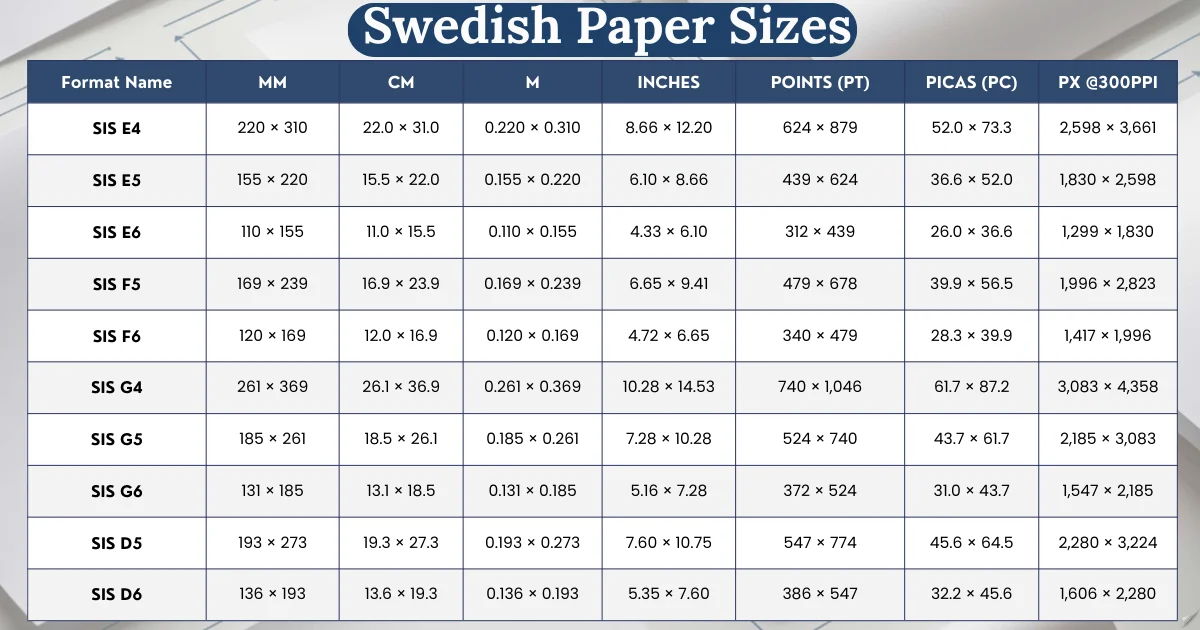
Swedish paper sizes follow a unique system called SIS 01 47 11 — a standard developed in Sweden that goes beyond the familiar ISO formats.
This standard took the global ISO A, B, and C series and extended them by adding four new series — D, E, F, and G — filling every gap between the existing international sizes.
What Are Swedish Paper Sizes?
Swedish Paper Sizes
The SIS standard adds “missing” sizes between international ISO standards.
ISO Standard Swedish Addition
Still Used Today
US Letter vs SIS G5
What makes the SIS system unique?
Each format follows a precise geometric progression, growing by a factor of ¹⁶√2 from one size to the next. This creates a perfectly ordered sequence: A4 → E4 → C4 → G4 → B4 → F4 → D4 → A3 — each step slightly larger than the last.
Was the SIS standard withdrawn?
Yes. The SIS 01 47 11 standard has since been officially withdrawn. However, two sizes — SIS G5 and SIS E5 — remain actively used in Sweden and the Netherlands, particularly for academic dissertation printing.
How do Swedish paper sizes compare to US formats?
The most commonly used American size, US Letter (215.9 × 279.4 mm / 8.5 × 11 in), sits close to but doesn’t match any SIS size exactly. SIS G5 (185 × 261 mm) is the closest equivalent in feel to US Letter for academic documents.
SIS E Series Paper Sizes
The SIS E series fits between the ISO A and ISO B formats in the Swedish size hierarchy.
SIS E5 (155 × 220 mm) and SIS E6 (110 × 155 mm) are the most recognized sizes in this series, with E5 used for dissertation printing and E6 commonly used for small booklets and specialty cards.
Who uses the SIS E series today?
Print professionals and academic publishers in Scandinavia still reference E5 and E6 regularly. For digital work, the px @300ppi values above are the exact numbers to input in Adobe Photoshop, Illustrator, or InDesign for print-ready output.
SIS F Series Paper Sizes
The SIS F series fills the gap between the E and G series within the full SIS progression.
It sits proportionally between those two series and is part of the complete geometric ladder that the SIS 01 47 11 standard established — even though F sizes are rarely seen in everyday commercial print today.
Practical note for designers: F series sizes are niche but occasionally surface in specialty archival printing, historical document reproduction, and European boutique publishing. If a client specifies an F format, these are your exact reference numbers.
SIS G Series Paper Sizes
The SIS G series bridges ISO B formats and the next larger ISO A size.
SIS G5 (185 × 261 mm) is the most widely recognized size in this entire series — actively used for dissertation printing in Sweden and the Netherlands even after the SIS standard was officially withdrawn.
Why does G5 stand out? Universities in Sweden and the Netherlands formally adopted G5 as their dissertation format — making it one of the very few SIS sizes that crossed into real institutional use beyond Sweden’s borders.
SIS D Series Paper Sizes
The SIS D series represents the largest of the four extended Swedish format groups.
One critical distinction no competitor clearly explains: The SIS D series and the German DIN D series cover the same physical sizes — but their numbering is offset by one. SIS D4 = German DIN D5. This matters when working across European borders on print projects.
For US-based designers ordering European print: Always confirm whether your European printer uses SIS D or DIN D numbering before submitting files — a one-number offset in naming can lead to the wrong paper size being cut.
FAQ’s (Swedish Paper Sizes)
What size paper is used in Sweden?
Sweden primarily uses ISO A4 (210 × 297 mm) for everyday documents, just like most of Europe. For academic and specialty work, SIS G5 (185 × 261 mm) and SIS E5 (155 × 220 mm) are the notable Swedish-specific formats still in active use.
Which one is bigger, A2 or A3?
A2 is bigger. A2 measures 420 × 594 mm (16.5 × 23.4 in), while A3 measures 297 × 420 mm (11.7 × 16.5 in). Each ISO A size is exactly half the area of the size above it.
What is A1, A2, A3, and A4?
These are sizes from the ISO 216 international paper standard. A1 is 594 × 841 mm, A2 is 420 × 594 mm, A3 is 297 × 420 mm, and A4 is 210 × 297 mm — each half the size of the one above it.
Is A6 the same as A4?
No. A6 (105 × 148 mm) is exactly one-quarter the size of A4 (210 × 297 mm). A6 is commonly used for postcards, flyers, and small notepads.
Is A3 or A5 bigger?
A3 is significantly bigger. A3 measures 297 × 420 mm while A5 measures only 148 × 210 mm — A3 is four times the area of A5.
What is A2 size?
A2 measures 420 × 594 mm (16.5 × 23.4 in). In digital terms at 300ppi, that equals 4,961 × 7,016 pixels. It is widely used for posters, architectural drawings, and large-format charts.
What measurements are used in Sweden?
Sweden uses the metric system — millimeters (mm) and centimeters (cm) are the standard units for paper and print measurements. Sweden adopted the metric system in the 1800s and has used it consistently ever since.
Which is bigger, A4 or A5?
A4 is bigger. A4 measures 210 × 297 mm (8.27 × 11.7 in) and is the global standard for office printing. A5 (148 × 210 mm) is half the size of A4 and commonly used for notebooks and brochures.
Do they use A4 paper in Europe?
Yes — A4 is the standard paper size across all of Europe, including Sweden, Germany, France, and the UK. It is defined under ISO 216 and used by governments, schools, and businesses continent-wide. The US remains one of the few countries that uses Letter size (215.9 × 279.4 mm) instead.
Conclusion
Swedish paper sizes under the SIS 01 47 11 standard represent one of the most mathematically precise and complete paper sizing systems ever created.
Even though the standard was officially withdrawn, its legacy lives on — especially in SIS E5 and SIS G5, which remain trusted formats for academic publishing in Northern Europe.
For designers, printers, and publishers working with international clients, knowing these sizes — in mm, cm, inches, pt, pc, and px — gives you a complete professional reference that competitors simply don’t offer in one place.

Hi, I’m Steven Henry, the creator behind Papersizechart.com. My goal is to make measurements easy for everyone, from paper sizes to everyday dimensions. I help you find the right paper for printing, crafts, or school projects and understand the measurements you need for your space or projects—all without the confusion. Let’s explore guides and charts together, so you can work with paper and dimensions confidently for any task.