Americans know Letter and Legal. But Britain once ran on something far richer — a system of paper sizes with names like Foolscap, Quarto, Imperial, Kings, and Dukes.
If you work with antique documents, fine art paper, historical archives, or vintage stationery, understanding traditional British paper sizes is genuinely practical — not just historical trivia.
What Are Traditional British Paper Sizes
Before the 1970s, British paper sizes had names, not numbers — and every name traced back to a watermark pressed into the sheet during manufacture.
Foolscap carried a jester’s head watermark first recorded in Britain in the mid-16th century. Imperial reflected royal authority. Post paper bore a post horn — signalling urgency in delivery. These were not marketing names. They were trade identities.
Britain formalised its Imperial paper sizing system in 1836 to bring consistency to a chaotic trade. Before that, different mills measured sheets differently — from the outside deckle edge or the inside — creating up to half an inch of variation on the same named size.
The Five Traditional British Paper Sizes
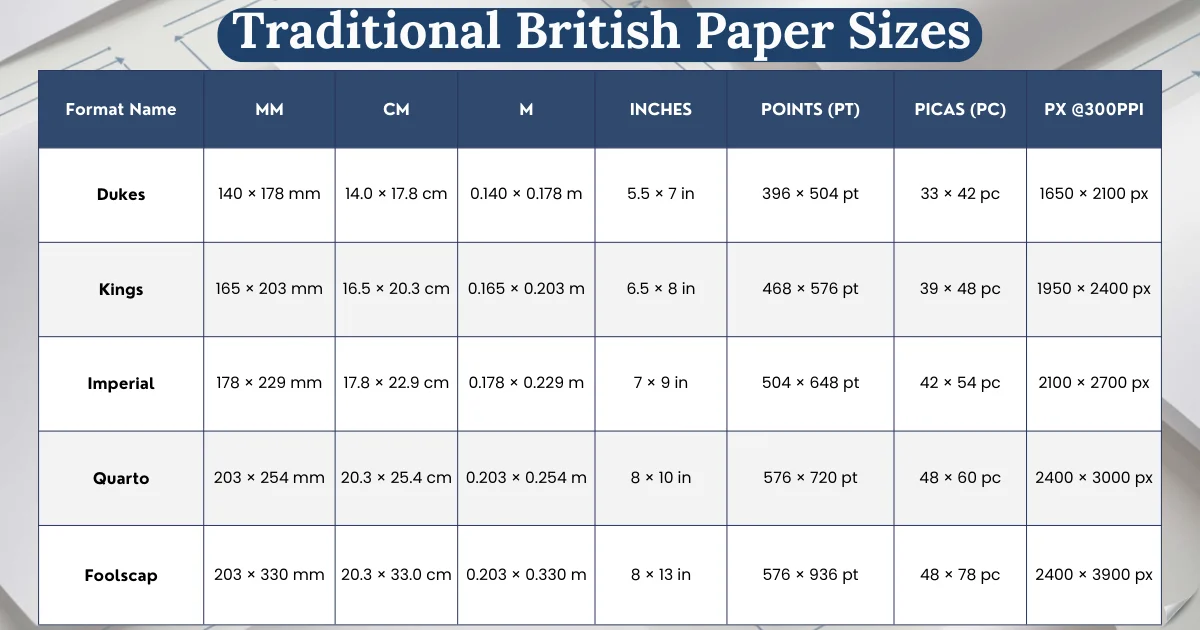
These five sizes defined British office, correspondence, and stationery culture for over a century.
Below is the complete master reference table — every size, every unit, one place:
Dukes
Dukes (140 × 178 mm / 5.5 × 7 in) was Britain’s most intimate writing paper — used for short personal notes, not office correspondence.
For US readers, it sits slightly smaller than a Half Letter (5.5 × 8.5 in) and feels closest to a large notecard or personal stationery card.
Kings
Kings (165 × 203 mm / 6.5 × 8 in) is the common alias for Foolscap Quarto — the result of folding the large uncut Foolscap sheet twice, giving exactly one quarter of the original area.
The word quarto is a bookbinding and printing term: two folds produce four leaves and eight printable pages. Kings was a versatile, everyday writing size — sitting just above Dukes in the traditional British size hierarchy.
Imperial
Imperial cut writing paper (178 × 229 mm / 7 × 9 in) was a standard mid-range correspondence sheet in the British stationery trade.
Here is what most competitors miss entirely: the name Imperial also refers to a much larger fine art sheet — 22 × 30 in (559 × 762 mm) — still actively sold in American art supply stores today for watercolour, etching, and printmaking.
This makes Imperial one of the only traditional British paper names still in daily use across the United States.
Quarto
Quarto (203 × 254 mm / 8 × 10 in) was the dominant British office and business correspondence paper through most of the 19th and early 20th centuries.
Historian David Lister recorded that Americans informally called US Letter “American Quarto” — because both sizes served the exact same professional role.
Foolscap
Foolscap Folio (203 × 330 mm / 8 × 13 in) was the workhorse of British offices for generations — used for reports, formal letters, and legal documents.
The name comes directly from its watermark — a jester’s head with bells and cap, first used in Britain in the mid-16th century, later replaced by the Britannia watermark in the 18th century.
The uncut parent Foolscap sheet measured 13¼ × 16½ in — “Folio” simply meant it had been folded once down the middle.
Traditional British Paper Sizes vs. Modern UK Sizes
Traditional British vs. Modern UK Sizes
In the 1970s, the UK adopted ISO 216. Centuries of tradition were replaced by mathematical efficiency.
Quarto
Brief
Kings
“British offices were still calling their A4 paper ‘Foolscap’ well into the mid-1980s. The identity outlasted the object.”
Stationery cupboards labeled Foolscap were routinely stocked with A4 sheets.Why ISO Won: Geometric Harmony
ISO A-Series
Halving any sheet creates the next size.
Constant 1:√2 Ratio.
Traditional Sizes
Inconsistent aspect ratios.
Scaling was wasteful & complex.
The UK officially adopted ISO 216 A-series paper sizes in the 1970s, aligning with Europe and most of the world.
A4 replaced Foolscap, Quarto, and Brief simultaneously. A5 stepped in for Dukes and Kings. Five names with centuries of history collapsed into one standard almost overnight.
What competitors rarely mention: the name “Foolscap” survived long after the paper itself was discontinued. British offices were still calling their A4 paper “Foolscap” well into the mid-1980s — stationery cupboards labelled Foolscap were routinely stocked with A4 sheets. The identity outlasted the object.
The reason ISO won is pure geometry. Every A-series sheet shares the Silver Ratio (1:√2) — halving any sheet always produces the next smaller size in the exact same proportion.
Dukes, Kings, Quarto, Foolscap, and Imperial had no such relationship — each had its own aspect ratio, making scaling and cutting wasteful and inconsistent.
Traditional British Paper Sizes vs. American Paper Sizes
Britain built its paper culture around watermarks, trade identity, and handcraft tradition. America built its system around typewriter carriage lengths and the economics of mass production. Two very different foundations.
Here is the direct side-by-side comparison US readers need:
Is US A4 the same as UK A4? Yes — completely identical. ISO 216 is a global standard. A4 measures 210 × 297 mm (8.27 × 11.69 in) whether you buy it in London, Chicago, or Sydney.
Is 8 × 10 the same as A4? No. 8 × 10 in (203 × 254 mm) is the old British Quarto size. A4 is measurably taller and slightly wider. They are not the same sheet.
The detail competitors consistently skip — paper weight conversion: US buyers of British or European paper will see gsm (grams per square metre) on the label.
Americans use lb basis weight, which shifts depending on paper grade and sheet size. To convert, multiply the lb-per-ream figure by the size factor — for Imperial (22 × 30 in): multiply by 2.08. For Royal: multiply by 2.81. To reverse, divide the gsm figure by the same number.
FAQ’s (Traditional British Paper Sizes)
What are the standard paper sizes in the UK?
Today the UK uses A4 (210 × 297 mm) as its everyday standard. Before metrication, the working sizes were Foolscap, Quarto, Kings, Imperial, and Dukes — each serving a specific correspondence or printing role.
Is Quarto the same as A4?
No. Quarto is 203 × 254 mm (8 × 10 in). A4 is 210 × 297 mm (8.27 × 11.69 in). A4 is noticeably taller. They served the same office purpose but are not interchangeable dimensions.
What are the old paper sizes?
The core old British Imperial paper sizes are Dukes, Kings, Quarto, Foolscap, and Imperial for cut writing sheets. Larger uncut sheets included Crown, Demy, Royal, Elephant, Antiquarian, and Atlas — used in printing, fine art, and bookbinding.
What size paper do they use in England?
A4 is the standard across English offices, schools, and homes. The traditional sizes like Foolscap and Quarto are no longer in commercial circulation — though Foolscap can still be sourced from specialist manufacturers such as James Cropper plc.
What is the most common paper size in Europe?
A4 (210 × 297 mm / 8.27 × 11.69 in) is the universal European standard. Every printer, copier, and office machine across the continent defaults to A4.
Is 8 × 10 the same as A4?
No. 8 × 10 in (203 × 254 mm) is Quarto — a traditional British size. A4 is taller and slightly wider. In US photography, 8 × 10 is a standard print size — but it matches no current ISO paper standard.
Conclusion
Traditional British paper sizes — Foolscap, Quarto, Kings, Imperial, and Dukes — are not museum pieces.
For Americans handling antique documents, fine art paper, bookbinding, or historical archives, these names are a living, practical vocabulary. And behind every name is a watermark. Behind every watermark is a craft tradition that ran for five centuries before a single sheet of A4 ever existed.

Hi, I’m Steven Henry, the creator behind Papersizechart.com. My goal is to make measurements easy for everyone, from paper sizes to everyday dimensions. I help you find the right paper for printing, crafts, or school projects and understand the measurements you need for your space or projects—all without the confusion. Let’s explore guides and charts together, so you can work with paper and dimensions confidently for any task.