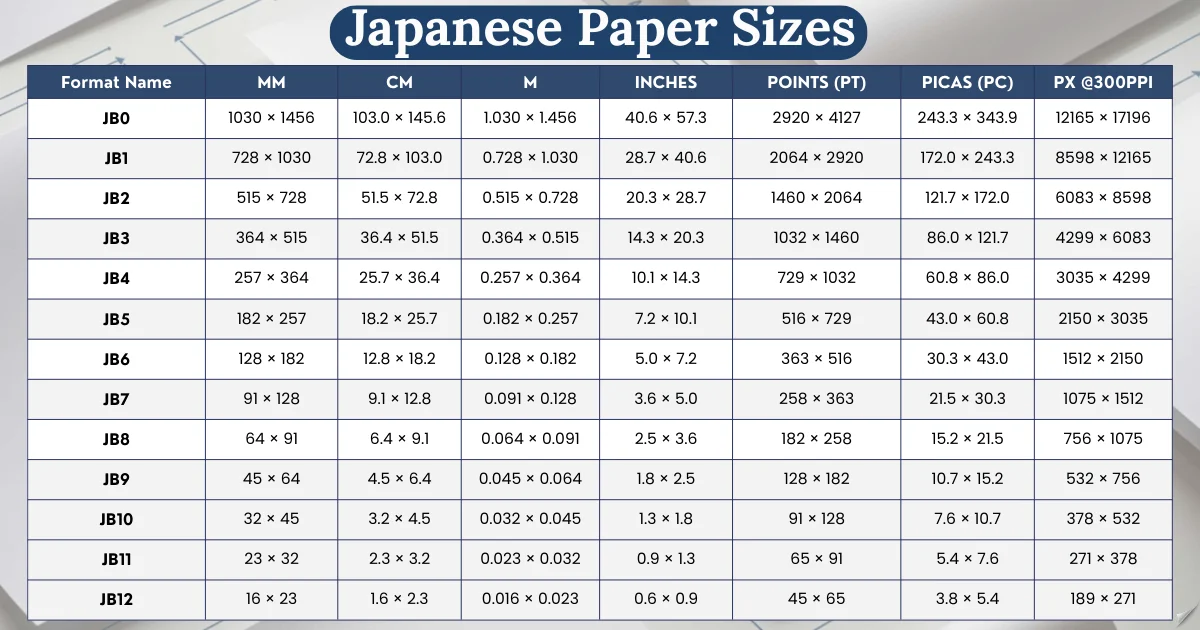
Japanese paper sizes use the JIS (Japanese Industrial Standards) system with A-series, B-series (JB0-JB12), and traditional Shiroku ban and Kiku formats. Japan primarily uses JB-series paper for daily documents, with JB5 as the standard school notebook size.
The JIS B-series is larger than A-series, offering more writing space for Japanese characters. Traditional formats like Shiroku ban for novels and Kiku sizes for manga magazines still dominate 40% of Japan’s publishing industry.
Understanding Japanese Paper Size Standards (JIS vs ISO)
Japanese paper sizes follow the JIS P 0138 standard, which closely mirrors the ISO 216 international standard with one crucial difference. While most countries primarily use A-series paper, Japan favors the B-series format for everyday use.
The JIS B-series (also called JB-series) is slightly larger than ISO B-series. A JB5 sheet measures 182 × 257 mm, whereas ISO B5 measures 176 × 250 mm. This makes Japanese B-series approximately 1.5 times the area of the corresponding A-series size.
US Letter paper (8.5 × 11 inches or 215.9 × 279.4 mm) sits between A4 and JB5 in size. American businesses working with Japanese partners often encounter compatibility issues when printing or formatting documents.
The JIS system uses a simple mathematical principle: each size is exactly half the area of the next larger size. Cutting a JB4 sheet in half produces two JB5 sheets, maintaining consistent aspect ratios of 1:√2 (approximately 1:1.414).
JIS A-Series Paper Sizes
The A-series format serves as the international standard for most document printing. Starting with A0 at 841 × 1189 mm, each subsequent size halves the previous one.
A4 paper dominates business correspondence globally. In Japan, A4 appears in official documents, international business letters, and government forms. It’s the most recognized international paper size.
A5 size works perfectly for small notebooks, pocket organizers, and promotional flyers. This compact format makes it ideal for portable materials that people carry daily.
A6 dimensions suit postcards, greeting cards, and small booklets. It’s roughly the size of a typical postcard used worldwide for personal correspondence.
JIS B-Series Paper Sizes
JB-series paper dominates Japanese daily life, from school notebooks to business documents. The series extends from JB0 through JB12, offering more size options than most international systems.
According to the Japan Paper Association, approximately 65% of paper sold in Japan is B-series format. JB5 and JB4 account for over 80% of office and educational paper consumption in the country.
JB4 paper serves as the standard for Japanese newspapers, business reports, and multi-page documents. Slightly larger than US Letter, it provides more space for content.
JB5 dimensions represent the most common notebook size in Japanese schools and offices. Students across Japan use JB5 notebooks daily for all their coursework and assignments.
JB7 measurements work perfectly for business cards (meishi), small notepads, and memo pads. This size accommodates Japanese characters better than Western business card formats.
Traditional Japanese Paper Sizes
Pre-JIS standardization dimensions still favored by publishers today.
| Format | mm | cm | Inches | pt | px @300ppi | Common Uses |
|---|---|---|---|---|---|---|
| Shiroku ban 4 | 264 × 379 | 26.4 × 37.9 | 10.4 × 14.9 | 749 × 1075 | 3118 × 4476 | Art books, photography collections |
| Shiroku ban 5 | 189 × 262 | 18.9 × 26.2 | 7.4 × 10.3 | 536 × 743 | 2232 × 3094 | Novels, literary publications |
| Shiroku ban 6 | 127 × 188 | 12.7 × 18.8 | 5.0 × 7.4 | 360 × 533 | 1500 × 2220 | Paperback books, compact manga |
| Kiku 4 | 227 × 306 | 22.7 × 30.6 | 8.9 × 12.0 | 644 × 868 | 2681 × 3614 | Fashion magazines, catalogs |
| Kiku 5 | 151 × 227 | 15.1 × 22.7 | 5.9 × 8.9 | 428 × 644 | 1783 × 2681 | Manga magazines, periodicals |
Shiroku ban and Kiku sizes predate the JIS standardization, rooted in traditional Japanese printing practices. Publishers still use these formats for books, magazines, and specialty printing.
The Shiroku ban name derives from “shiro” (white) and “roku” (six), referencing traditional paper manufacturing methods. Kiku format comes from the chrysanthemum (kiku) flower, symbolizing quality in Japanese culture.
Traditional Japanese publishing houses maintain these sizes because established printing equipment and reader expectations favor these dimensions. The Publishing News Agency reports that 40% of Japanese books still use Shiroku ban or Kiku formats.
Special Japanese Paper Formats
Japanese business cards (meishi) and postal cards follow specific standards that differ from Western equivalents.
Japanese business cards measure 91 × 55 mm, slightly larger than US cards (3.5 × 2 inches). This JB7-based format accommodates Japanese characters better and follows business etiquette standards.
Hagaki postcards standardize at 100 × 148 mm, matching the A6 format. Japan Post issues official postal cards in this exact size for domestic and international mail.
Japanese Paper Size Conversion Chart and Practical Guide
Converting between Japanese and US paper sizes requires understanding dimensional differences. No direct equivalents exist between JIS and US Letter/Legal formats.
JB4 to US Letter: JB4 (257 × 364 mm) is taller and narrower than US Letter (216 × 279 mm). Content designed for JB4 needs margin adjustments when printing on Letter-size paper.
Quick Comparison: Japanese vs US Paper Sizes
JB5 vs A5: JB5 measures 182 × 257 mm while A5 is 148 × 210 mm. JB5 is significantly larger, providing about 27% more surface area than A5.
Most modern printers support custom paper sizes. In Microsoft Word, navigate to Page Setup > Paper Size > More Paper Sizes to enter Japanese dimensions in millimeters.
Adobe software users can add JB-series presets through Document Setup. Enter dimensions in millimeters: JB5 (182 × 257 mm), JB4 (257 × 364 mm), ensuring correct bleed settings for professional printing.
Size hierarchy from largest to smallest: A0 > A1 > A2 > A3 > A4 > A5 > A6. Similarly, JB0 > JB1 > JB2 > JB3 > JB4 > JB5 > JB6 > JB7.
Comparing A and JB series: JB5 sits between A5 and A4 in size. JB4 exceeds A4 dimensions, making it closer to US Legal paper in overall area.
When ordering paper for Japanese projects in the US, specify exact millimeter dimensions. Most commercial printers can accommodate custom cuts from standard sheets.
Digital file preparation: Set resolution to 300 ppi for professional printing. A JB5 document should be 2150 × 3035 pixels, while JB4 requires 3035 × 4299 pixels.
Common conversion mistakes include assuming B5 equals JB5 (ISO B5 is 176 × 250 mm, not 182 × 257 mm) and confusing Shiroku ban sizes with JIS standards.
FAQ’s (Japanese Paper Sizes)
What paper sizes does Japan use?
Japan primarily uses JIS B-series (JB0-JB12) for everyday documents, education, and business. The country also employs A-series for international correspondence and traditional formats like Shiroku ban and Kiku for publishing. JB5 dominates schools while JB4 serves business needs.
Is JIS B5 the same as A5?
No, JB5 and A5 differ significantly. JB5 measures 182 × 257 mm (7.17 × 10.12 inches) while A5 is 148 × 210 mm (5.83 × 8.27 inches). JB5 is approximately 27% larger than A5 in total area.
Why do books have 10 9 8 7 6 5 4 3 2 1?
This number line indicates the printing run or edition. Publishers remove the lowest number with each reprint. If “1” appears, you have a first edition first printing. If “3” is the lowest, it’s the third printing. This system helps collectors and librarians identify book versions.
Conclusion
Japanese paper sizes operate through the JIS system, favoring B-series formats over the globally common A-series. Understanding JB0 through JB12, along with traditional Shiroku ban and Kiku sizes, proves essential for anyone working with Japanese documents or publications.
The dimensional differences between Japanese and US paper formats require careful attention when converting files or printing materials. Using exact millimeter measurements and proper software settings ensures professional results across different paper standards.

Hi, I’m Steven Henry, the creator behind Papersizechart.com. My goal is to make measurements easy for everyone, from paper sizes to everyday dimensions. I help you find the right paper for printing, crafts, or school projects and understand the measurements you need for your space or projects—all without the confusion. Let’s explore guides and charts together, so you can work with paper and dimensions confidently for any task.