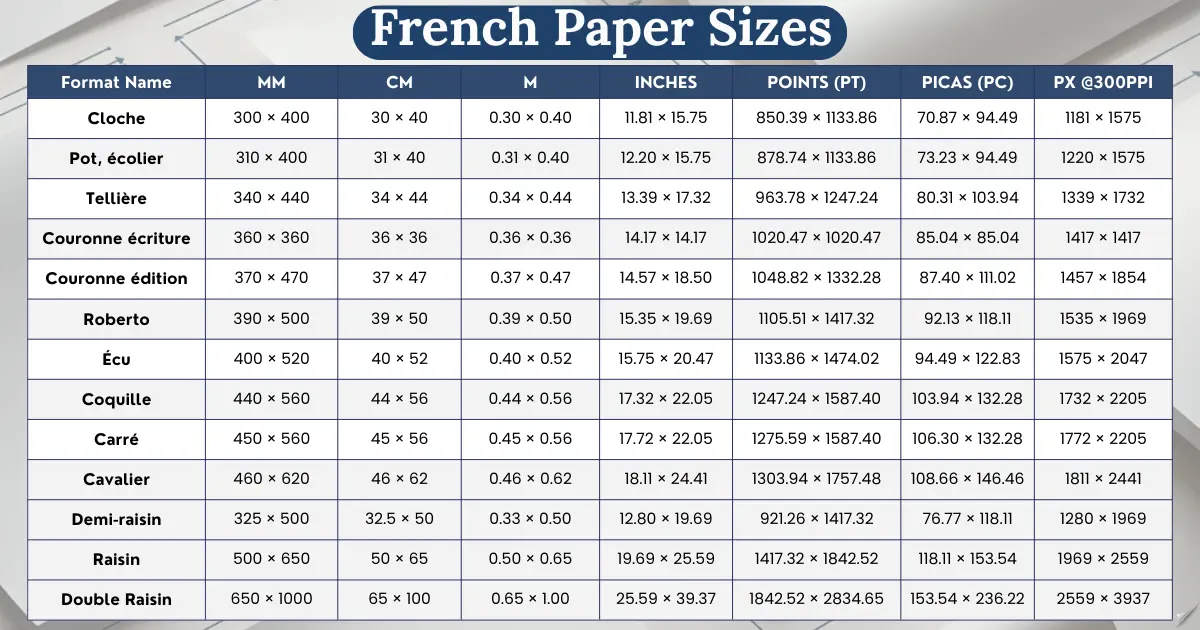
French paper sizes include 21 traditional formats from Cloche (300 × 400 mm) to Univers (1000 × 1130 mm), established under the AFNOR standard in 1926. Popular formats like Tellière, Raisin, Jésus, and Grand Aigle use intelligent doubling systems where larger sheets cut into exact smaller sizes without waste.
France adopted ISO standards in 1967, but traditional sizes like Raisin (500 × 650 mm) remain essential for watercolor artists and specialty printing worldwide.
These formats differ completely from US Letter (8.5 × 11 inches) and Legal sizes, creating unique considerations for Americans working with French documents, importing European art, or purchasing specialty paper.
Complete French Paper Size Chart
This comprehensive chart presents all 21 traditional French paper formats with exact measurements in millimeters, inches, centimeters, meters, points, picas, and pixels at 300ppi. Each format includes its historical name, dimensions, and aspect ratio for quick reference.
The sizes range from small Cloche (300 × 400 mm) to massive Univers (1000 × 1130 mm), organized by category for easy navigation. These measurements help professionals working with French documents, importing European art, or using traditional watercolor paper from manufacturers like Arches and Canson.
French Paper Sizes vs US Paper Sizes
US Letter measures 8.5 × 11 inches (216 × 279 mm). The closest French equivalent, Cloche at 11.8 × 15.7 inches, is significantly larger.
US Legal is 8.5 × 14 inches (216 × 356 mm). French Tellière at 13.4 × 17.3 inches provides more width and height.
US Tabloid measures 11 × 17 inches (279 × 432 mm). French formats like Couronne édition (14.6 × 18.5 inches) exceed these dimensions.
Raisin paper at 19.7 × 25.6 inches has no direct US equivalent. The closest is Arch B at 12 × 18 inches, which is substantially smaller.
Americans encounter French paper sizes when importing art prints or purchasing watercolor paper from Arches or Canson, which still produce traditional Raisin-sized sheets.
Museums and galleries need custom frames for French-sized artwork, as standard US frame sizes don’t accommodate dimensions like Jésus or Colombier.
Understanding French Paper Size Relationships
Carré measures 450 × 560 mm. When doubled, it becomes Grand Monde at 900 × 1260 mm. The smallest dimension (450mm) doubles to 900mm.
Cloche at 300 × 400 mm quadruples perfectly to Soleil at 600 × 800 mm. One Soleil sheet yields four exact Cloche sheets without waste.
The Raisin family shows systematic sizing. Demi-raisin (325 × 500 mm) is half the standard. Raisin (500 × 650 mm) is the base size. Double Raisin (650 × 1000 mm) doubles it.
Colombier affiche (600 × 800 mm) suited poster printing. Colombier commercial (630 × 900 mm) provided extra margin for business use.
This doubling system reduced waste in traditional paper production and allowed efficient cutting from large sheets to smaller formats.
Common Uses and Applications of French Paper Sizes Today
Proportional comparison of traditional French sizes.
- Supply: Available through specialty importers like Legion Paper.
- Framing: Standard US frames do not fit. Requires custom framing for accuracy.
- Museums: Essential for reproduction work to match historical dimensions.
Raisin watercolor paper remains an international standard. Companies like Arches produce 500 × 650 mm sheets for watercolor artists worldwide. Raisin is among the top three sizes for professional watercolorists.
Jésus format (560 × 760 mm) was prized for lithography and printmaking. Artists like Henri de Toulouse-Lautrec created posters on Jésus-sized sheets. Contemporary printmakers still request this dimension for fine art editions.
Colombier affiche (600 × 800 mm) targeted poster advertising. This dimension provided ideal proportions for street posters in French cities during the Belle Époque.
Grand Aigle (750 × 1050 mm) serves architectural drawings and engineering plans. Some European firms prefer this over ISO A1 for technical applications.
American consumers can purchase French-sized paper through specialty suppliers like Legion Paper. Art supply stores import French watercolor paper in traditional dimensions.
Custom printing costs for French formats typically run 15-30% higher than standard US sizes. Non-standard dimensions require special cutting and handling in American print shops.
Museums use French paper sizes for reproduction work, where matching original dimensions preserves historical accuracy. Standard US frames don't fit these sizes, necessitating custom framing.
FAQ’s (French Paper Sizes)
What size is French paper?
French paper includes 21 traditional sizes ranging from Cloche at 300 × 400 mm (11.8 × 15.7 inches) to Univers at 1000 × 1130 mm (39.4 × 44.5 inches). The most common formats are Tellière (340 × 440 mm), Raisin (500 × 650 mm), and Jésus (560 × 760 mm), each serving different historical purposes.
What is A3 paper called in the US?
A3 doesn't have a specific American name but is closest to US Tabloid or Ledger at 11 × 17 inches. However, A3 actually measures 11.7 × 16.5 inches, making it slightly different in proportions.
Are French sizes the same as US?
No, traditional French paper sizes differ completely from US formats. US Letter (8.5 × 11 inches) has no direct French equivalent, and formats like Raisin (19.7 × 25.6 inches) or Tellière (13.4 × 17.3 inches) are unique to the French system.
Conclusion
French paper sizes preserve important printing heritage through 21 distinct formats. From Cloche (300 × 400 mm) to Univers (1000 × 1130 mm), each dimension served specific purposes in French commerce, art, and documentation.
While France adopted ISO standards in 1967, formats like Raisin remain vital for watercolor artists globally. Understanding these traditional sizes helps when working with historical documents, importing European art, or using specialty paper from French manufacturers.
The systematic relationships between sizes, like the Raisin family or double formats, demonstrate thoughtful design. These proportions differ fundamentally from both US Letter/Legal and ISO A-series standards, offering unique options for contemporary applications.

Hi, I’m Steven Henry, the creator behind Papersizechart.com. My goal is to make measurements easy for everyone, from paper sizes to everyday dimensions. I help you find the right paper for printing, crafts, or school projects and understand the measurements you need for your space or projects—all without the confusion. Let’s explore guides and charts together, so you can work with paper and dimensions confidently for any task.