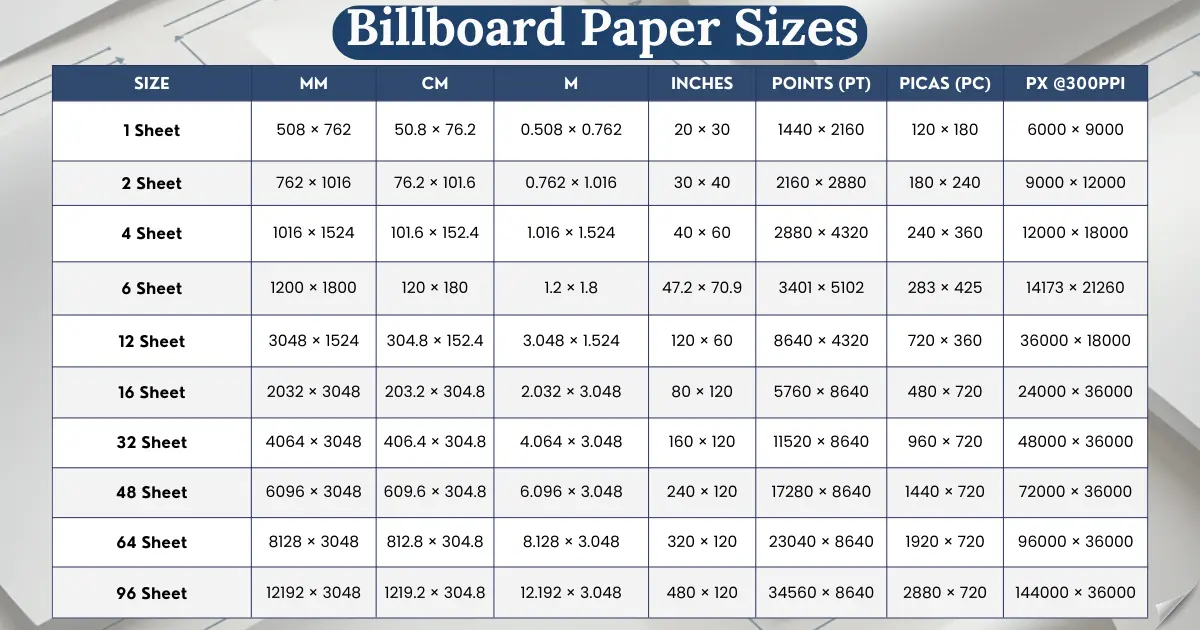
Billboard paper sizes are standardized dimensions used for outdoor advertising displays. These sizes range from small 1 Sheet posters at 508 × 762 mm to massive 96 Sheet billboards measuring 12192 × 3048 mm.
The naming system comes from the old practice of creating large advertisements by combining multiple printed poster panels.
Understanding standard billboard sizes helps advertisers, designers, and businesses choose the right format for their campaigns. Each size serves specific purposes based on location, viewing distance, and traffic patterns across the USA.
Understanding the Billboard Sheet System
The billboard sheet system started in the early days of printing when large ads were made by gluing multiple paper sheets together. A 1 Sheet was the smallest unit, and printers combined several sheets to make bigger signs.
Today, modern printers can create entire billboards in one piece, but the old naming system still helps advertisers understand sizes and costs.
Small-format billboards like 1 to 6 Sheet work well in cities, bus stops, and shopping areas where people walk by slowly. Large-format billboards from 12 to 96 Sheet are built for highways and busy roads where drivers need to read messages quickly from far away.
The Bulletin billboard at 48 feet × 14 feet (14630 × 4267 mm) is actually the biggest standard size available. It’s even larger than a 96 Sheet and gives advertisers the most space for highway campaigns where maximum visibility matters most.
Standard Billboard Sizes Chart
Billboard dimensions vary significantly to accommodate different advertising environments and viewing distances.
The following comprehensive chart details all standard billboard sizes used across the United States, with precise measurements in millimeters, centimeters, meters, inches, points, picas, and pixels at 300 PPI resolution.
Each format serves specific placement scenarios ranging from indoor retail displays to massive highway installations.
Billboard Paper Types and Printing Materials
Vinyl billboard material dominates outdoor advertising due to superior weather resistance and durability. Heavy-duty 13-ounce vinyl withstands rain, wind, and UV exposure for 6-12 months of continuous display without significant fading or deterioration.
Mesh vinyl billboards feature tiny perforations that allow wind to pass through, reducing stress on mounting structures. These wind-resistant materials are essential for large-format installations in areas with frequent high winds or storms.
Paper-based billboards still exist for short-term campaigns and indoor applications. Premium poster paper stock weighing 150-200 GSM provides adequate strength for temporary displays lasting 2-4 weeks in protected environments.
Backlit billboard materials use translucent fabrics or specialty vinyl that allows light transmission. These illuminated displays create dramatic nighttime visibility and typically use lighter-weight materials (8-10 ounce vinyl) that maximize light passage.
Modern eco-friendly billboard substrates include recyclable polyethylene and biodegradable fabric options. Some companies now offer PVC-free vinyl alternatives that reduce environmental impact while maintaining outdoor durability standards.
UV-resistant coatings extend billboard lifespan significantly. Professional-grade laminates and protective layers can double the effective display period by preventing color degradation from constant sun exposure.
Choosing the Right Billboard Size for Your Campaign
Choosing the Right Billboard Size
Highway drivers traveling 65+ mph need 48 to 96 Sheet billboards to read messages in the 3-5 seconds of visibility they have.
Traffic speed determines optimal billboard size more than any other factor. Highway drivers traveling 65+ mph need 48 to 96 Sheet billboards to read messages in the 3-5 seconds of visibility they have.
Viewing distance calculations follow a simple rule: use 1 foot of billboard height for every 10 feet of viewing distance. A 32 Sheet billboard at 10 feet tall works well for locations with 100-foot sightlines.
Urban billboard placement favors smaller formats between 4 and 16 Sheet sizes. Pedestrians and slow-moving traffic can absorb more detailed messages from these closer-range displays.
Budget considerations scale directly with size. A 6 Sheet billboard typically costs 60-70% less than a 48 Sheet for both production and rental fees, making it ideal for local businesses with limited advertising budgets.
Message complexity should decrease as billboard size increases. Large highway billboards perform best with 7 words or fewer, while smaller urban formats can accommodate up to 15 words if viewing time permits.
Local zoning regulations vary significantly across USA markets. Some municipalities restrict billboard dimensions to specific maximums or prohibit certain sizes in historic or residential districts.
Campaign duration affects material choices and cost-effectiveness. Short campaigns under 30 days can use paper-based materials, while long-term placements exceeding 6 months require durable vinyl substrates to maintain appearance.
FAQ’s (Billboard Paper Sizes)
What are standard billboard sizes?
The ten standard billboard sizes in the USA include 1 Sheet (508 × 762 mm), 2 Sheet (762 × 1016 mm), 4 Sheet (1016 × 1524 mm), 6 Sheet (1200 × 1800 mm), 12 Sheet (3048 × 1524 mm), 16 Sheet (2032 × 3048 mm), 32 Sheet (4064 × 3048 mm), 48 Sheet (6096 × 3048 mm), 64 Sheet (8128 × 3048 mm), and 96 Sheet (12192 × 3048 mm).
What is 24×36 paper called?
A 24 × 36 inch poster (609.6 × 914.4 mm) is called “Architectural D size” and is commonly used for engineering drawings and architectural prints. This size is slightly smaller than a 1 Sheet billboard and works well for indoor poster displays.
What paper is used for billboards?
Vinyl material (13-15 ounce weight) is the main material for outdoor billboards because it resists weather and lasts 6-12 months. Heavy poster paper (150-200 GSM) works for short-term indoor displays or temporary outdoor use under 30 days.
What size is a 30 sheet billboard?
A 30 Sheet billboard is not a standard USA size—it’s part of the European billboard system measuring about 10 × 20 feet. The closest American equivalent is the 32 Sheet at 4064 × 3048 mm with similar display area.
What size is a 32 sheet billboard?
A 32 Sheet billboard measures 4064 × 3048 mm (160 × 120 inches), which equals about 13.3 feet wide by 10 feet tall. This popular roadside format works great on roads with traffic speeds between 35-55 mph.
How big is a 48 sheet billboard?
A 48 Sheet billboard is 6096 × 3048 mm (240 × 120 inches), which equals 20 feet wide by 10 feet tall. This highway billboard size is one of the most common formats for interstate advertising.
What are the different size billboards?
Billboard sizes range from small 1 Sheet posters at 508 × 762 mm to massive 96 Sheet displays at 12192 × 3048 mm. The complete series includes 1, 2, 4, 6, 12, 16, 32, 48, 64, and 96 Sheet formats, plus the Bulletin size at 48 × 14 feet.
What does 970×250 look like?
A 970 × 250 pixel dimension is a digital website banner ad called a leaderboard, not a physical billboard size. This online ad format appears at the top of web pages and has no equivalent in physical billboard measurements.
What size is a 96 sheet billboard?
A 96 Sheet billboard measures 12192 × 3048 mm (480 × 120 inches), which equals 40 feet wide by 10 feet tall. This is the largest sheet-based billboard format, though the Bulletin size at 48 × 14 feet actually offers more total display area.
Conclusion
Billboard paper sizes follow a standardized sheet system that ranges from compact 508 × 762 mm posters to massive 12192 × 3048 mm highway displays. Understanding these standard dimensions helps advertisers select appropriate formats for specific locations and viewing conditions.
Choosing the right billboard size depends on traffic speed, viewing distance, budget, and message complexity. Small urban formats work for pedestrian areas, while large highway billboards require simple, bold designs readable at high speeds.

Hi, I’m Steven Henry, the creator behind Papersizechart.com. My goal is to make measurements easy for everyone, from paper sizes to everyday dimensions. I help you find the right paper for printing, crafts, or school projects and understand the measurements you need for your space or projects—all without the confusion. Let’s explore guides and charts together, so you can work with paper and dimensions confidently for any task.