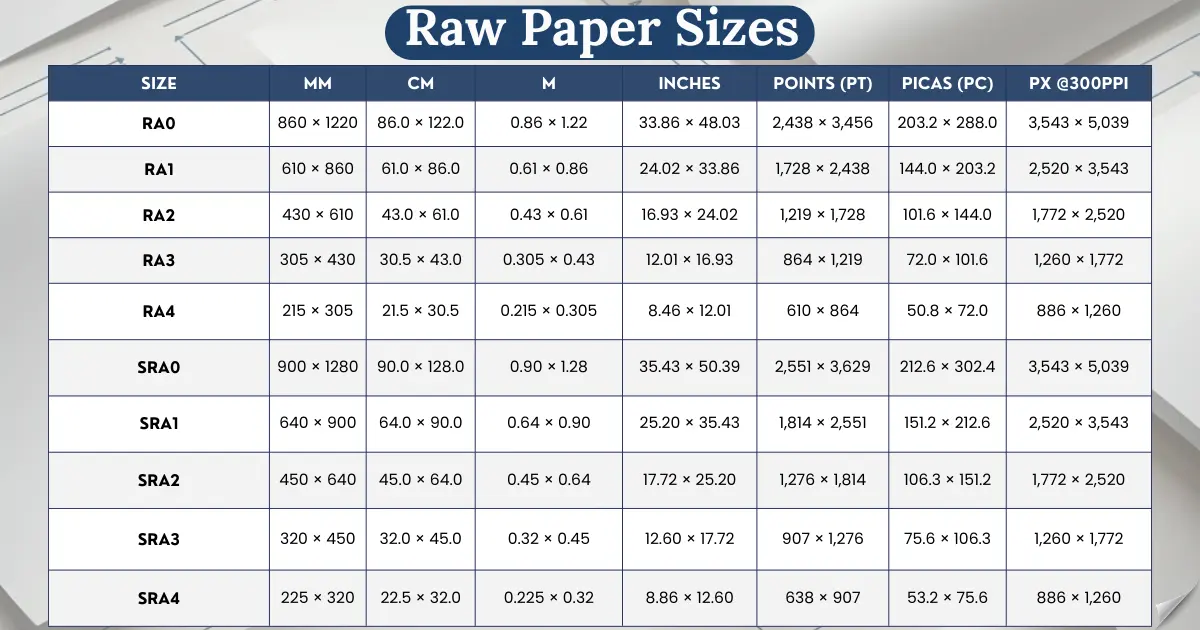
RAW paper sizes are untrimmed printing formats with extra margins for bleed and precise cutting. The ISO 217 system includes RA Series (standard), SRA Series (extra bleed), and AU Series (untrimmed A-formats)—19 sizes total from RA0 (860×1220mm) to RA4 (215×305mm).
These formats prevent white edges by providing 3-10mm extra space beyond final dimensions. After printing, RAW paper trims to standard A-series—RA4 becomes A4, delivering professional edge-to-edge results impossible with standard paper.
Complete RAW Paper Size Chart
RA0 delivers maximum printing space at 860 × 1220 mm (33.9 × 48 inches). That’s 33.86 × 48.03 inches or 2,480 × 3,515 pixels at 300 PPI.
RA1 cuts that in half to 610 × 860 mm (24 × 33.9 inches). Convert that to 24.02 × 33.86 inches or 1,756 × 2,480 pixels for digital work.
RA2 works perfectly for posters at 430 × 610 mm (16.93 × 24.02 inches). You’re looking at 1,239 × 1,756 pixels at standard print resolution.
RA3 handles brochures and flyers with 305 × 430 mm (12.01 × 16.93 inches) dimensions. That translates to 878 × 1,239 pixels when designing digitally.
RA4 is the workhorse size at 215 × 305 mm (8.46 × 12.01 inches). Most commercial printers keep this stocked for everyday letter-size jobs requiring bleed.
The halving principle makes RAW sizes logical. Each dimension splits perfectly in half as you go down the series. RA1 is exactly half of RA0.
SRA Paper Sizes Decoded
SRA paper formats deliver the extra margin space that full-bleed printing demands. This section breaks down all SRA dimensions—from SRA0 through SRA4 plus extended formats (SRA1+, SRA2+, SRA3+, SRA3++)—across every measurement unit professionals need: millimeters, centimeters, meters, inches, points, picas, and pixels at 300 PPI for complete design workflow clarity.
SRA Series Complete Measurement Table:
SRA formats offer even more breathing room than RA sizes. The “Supplementary” designation means extra bleed allowance for demanding print jobs.
SRA0 dominates large-format printing at 900 × 1280 mm (35.43 × 50.39 inches). That’s 3,543 × 5,039 pixels at 300 PPI resolution.
SRA1 measures 640 × 900 mm (25.20 × 35.43 inches). Digital designers work with 2,520 × 3,543 pixels when preparing files.
SRA2 sits at 450 × 640 mm (17.72 × 25.20 inches) or 1,772 × 2,520 pixels. Magazine printers love this size for full-spread layouts.
SRA3 provides 320 × 450 mm (12.60 × 17.72 inches) working space. Convert to 1,260 × 1,772 pixels for design software setup.
SRA4 gives you 225 × 320 mm (8.86 × 12.60 inches). That’s 886 × 1,260 pixels when creating print-ready files.
SRA Extended Formats Measurement Table:
SRA1+ extends to 660 × 920 mm (25.98 × 36.22 inches) for complex registration needs. Think 2,598 × 3,622 pixels in Photoshop.
SRA2+ measures 480 × 650 mm (18.90 × 25.59 inches). Your design file needs 1,890 × 2,559 pixels at standard resolution.
SRA3+ offers 320 × 460 mm (12.60 × 18.11 inches) dimensions. The extra 10mm over SRA3 helps with grip edges during printing.
SRA3++ maxes out at 320 × 464 mm (12.60 × 18.27 inches). That tiny 4mm difference accommodates specific press requirements.
The truth about SRA versus RA: SRA paper costs 8-12% more but eliminates do-overs from insufficient bleed. Professional printers consider it insurance.
Full-bleed photography demands SRA formats. The extra margin ensures no white edges appear after trimming, even with slight cutting variations.
Untrimmed A-Series
A0U bridges traditional and RAW formats at 880 × 1230 mm (34.65 × 48.43 inches). Convert to 3,465 × 4,843 pixels for digital preparation.
A1U measures 625 × 880 mm (24.61 × 34.65 inches). That’s 2,461 × 3,465 pixels when designing for this untrimmed format.
A2U delivers 450 × 625 mm (17.72 × 24.61 inches) workspace. Your graphics software needs 1,772 × 2,461 pixel canvases.
A3U sits at 330 × 450 mm (12.99 × 17.72 inches). Digital files require 1,299 × 1,772 pixels at 300 PPI.
A4U provides 240 × 330 mm (9.45 × 12.99 inches) printing area. Set up designs at 945 × 1,299 pixels for perfect output.
Untrimmed A-Series (AU) Complete Measurement Table:
The “U” designation means Untrimmed A-series equivalent. Book printers prefer AU formats for consistent finishing across large runs.
AU sizes fall between RA and SRA in terms of bleed allowance. You get more room than standard A-series but less than full SRA formats.
North American printers stock AU formats less frequently. European print houses keep AU paper readily available for book publishing and packaging work.
Choosing the Right RAW Paper Size
RA formats handle 90% of commercial printing needs. The standard bleed allowance works for business cards, brochures, and basic marketing materials.
SRA formats shine with full-bleed photography. Wedding albums, art prints, and high-end catalogs demand that extra margin for trimming precision.
AU formats excel in book production. Publishers value the consistency when trimming hundreds of pages to identical dimensions.
Calculate your actual needs: 3mm bleed minimum for simple jobs, 5mm for standard work, and 10mm for critical edge-to-edge designs.
Digital presses handle RAW sizes differently than offset printing. Offset requires larger SRA formats because mechanical registration needs more grip space.
Paper waste matters economically. RA4 generates approximately 4% waste when trimmed to A4, while SRA4 produces closer to 8% waste.
Real-World Applications: When to Use Each RAW Paper Format
Corporate brochures typically use RA3 or RA4 stock. The standard bleed allowance handles most logo placements and background colors without issues.
Magazine publishers demand SRA2 for spreads that bleed across center gutters. That extra margin prevents color shifting at the spine.
Art book production relies on AU formats because trimming consistency matters more than maximum bleed. A2U and A3U dominate this market.
Poster printing almost always requires SRA1 or SRA0 sheets. Photographers need that extra margin when images extend to all four edges.
Packaging prototypes start with SRA3+ because die-cutting requires additional registration marks and crop marks outside the final trim area.
The printing industry truth: choosing wrong RAW sizes costs 15-20% in wasted materials according to European printing associations.
Technical Specifications: Understanding RAW Paper Measurements
ISO 217 standards use metric measurements exclusively. All RAW sizes work in millimeters, not inches like US paper.
Centimeter conversion is simple: divide millimeters by 10. RA4 = 21.5 × 30.5 cm, SRA4 = 22.5 × 32.0 cm.
Point measurements for typography: RA4 = 609 × 864 points (72 points per inch). Pica conversions: RA4 = 50.75 × 71.75 picas (6 picas per inch).
Pixel dimensions at 300 PPI: RA4 needs 2,539 × 3,602 pixels, SRA4 needs 2,657 × 3,780 pixels for print-ready files.
All RAW sizes share the same aspect ratio: √2 proportion (1:1.4142) inherited from A-series paper. This ensures consistent scaling across formats.
Paper weight affects handling: 80gsm feels flimsy on RA0 but works perfectly on RA4. Larger sizes need heavier stock.
Common Mistakes When Ordering RAW Paper Sizes
Common Mistakes When Ordering RAW Paper Sizes
Avoid these critical errors to ensure your documents print correctly without panic or extra costs.
The Size Problem
A4 (ISO 216)
The global standard. Most US businesses accept A4 without issue.
RA4 (US Raw)
Slightly larger dimensions (216 × 279mm). Confusing with A4 causes panic when files don’t fit.
File & Paper Mismatch
Designers confusing RA4 with A4 causes panic. Your 5mm design might not fit on the actual stock.
Cost Bleed
Ordering specialized raw formats inflates costs. Business cards don’t need RA4. Simple SRA4 is cheaper.
Imperial vs Metric
Mixing inches and millimeters leads to compounding errors. Always specify Millimeters for 217 formats.
Ignoring Bleed
Printers need 5mm bleed for cutting tolerance. Assuming no bleed results in ugly white edges.
Correct Ordering Practices
✓ Verify Stock
Ask your printer specifically for RA4 availability. Don’t assume A4 compatibility.
✓ Check Bleed
Design with 5mm bleed on all edges (top, bottom, left, right) for all full-bleed jobs.
✓ Metric First
Use Millimeters (e.g., 216 × 279) for all European raw formats to avoid US conversion errors.
✓ Request Proofing
Get a physical proof before the final run to catch mismatched dimensions early.
Designers often confuse RA4 with A4. That 5mm difference per edge causes panic when files don’t fit the actual paper stock.
Assuming all printers stock all sizes creates deadline disasters. Most US print shops only carry RA4 and SRA3 regularly.
Forgetting to account for grip edges wastes the extra SRA margin. Printers need 5-10mm on one edge for mechanical feeding systems.
Ordering SRA when RA suffices inflates costs unnecessarily. Simple business cards don’t need supplementary raw format margins.
Mixing metric and imperial measurements causes compounding errors. Always work in millimeters when dealing with ISO 217 formats.
The expensive mistake: assuming printer bleeds equal paper bleeds. Your 3mm design bleed needs 5mm paper bleed for cutting tolerance.
FAQ’s (Raw Paper Sizes)
What size do RAW papers come in?
RAW papers come in 19 standard sizes: RA Series (RA0, RA1, RA2, RA3, RA4), SRA Series (SRA0, SRA1, SRA2, SRA3, SRA4), SRA Extended (SRA1+, SRA2+, SRA3+, SRA3++), and Untrimmed A-Series (A0U, A1U, A2U, A3U, A4U). RA4 (215×305mm) is most common.
What are the different types of RAW papers?
Three types: RA Series for standard printing with basic bleed, SRA Series for full-bleed work with extra margins, and AU Series for book production. Each type serves different professional printing needs.
What is a 24×36 paper size called?
24×36 inches is ARCH D architectural paper (609.6×914.4mm). This isn’t part of ISO 217 RAW standards. Closest RAW size is between RA1 (610×860mm) and RA0 (860×1220mm).
Are king size cones bigger than 1¼?
This question refers to rolling papers, not printing paper. RAW paper sizes (ISO 217) don’t use “king size” or “1¼” designations. These terms belong to smoking papers.
Is 1¼ bigger than king size?
This relates to rolling papers, not RAW printing formats. ISO 217 RAW sizes use millimeters, not fractions. The 1¼ naming applies only to smoking papers.
Why did RAW get a lawsuit?
The 2024 lawsuit targeted RAW brand rolling papers for marketing claims. ISO 217 RAW paper sizes (printing standards) are unrelated to this legal case. The papers remain legal.
Why are rolling papers 1¼?
This question concerns smoking papers, not printing paper. RAW printing formats use millimeters (like RA4 = 215×305mm), not fractional measurements. Different products entirely.
What is the standard size for rolling papers?
This asks about smoking papers. For RAW printing formats, RA4 (215×305mm) is the standard commercial size. It trims to A4 documents after printing.
Conclusion
RAW paper sizes solve real printing challenges with standardized bleed allowances. Choose RA formats for everyday work, SRA for full-bleed perfection, and AU for book production.
The math stays simple: larger RAW sizes prevent white edges after trimming. Your designs deserve professional finishing that only untrimmed formats provide.
Start with RA4 for testing, then scale to larger formats as projects demand. Proper RAW size selection eliminates costly reprints and delivers flawless edge-to-edge results every time.

Hi, I’m Steven Henry, the creator behind Papersizechart.com. My goal is to make measurements easy for everyone, from paper sizes to everyday dimensions. I help you find the right paper for printing, crafts, or school projects and understand the measurements you need for your space or projects—all without the confusion. Let’s explore guides and charts together, so you can work with paper and dimensions confidently for any task.