Book paper sizes aren’t just measurements—they’re strategic decisions affecting printing costs, reader perception, and sales potential. From massive Folio formats (12×15″) to tiny 64mo miniatures (2×3″), each dimension serves specific purposes in publishing history and modern markets.
The industry standard 6×9 inches (Royal Octavo) dominates 70% of nonfiction, while 5×8 inches (Crown Octavo) rules genre fiction. Understanding traditional formats (Folio, Quarto, Octavo, 12mo through 64mo) and modern systems (A/B/C Formats, KDP specifications) helps authors choose sizes that maximize profitability, meet platform requirements, and match reader expectations across different genres and markets.
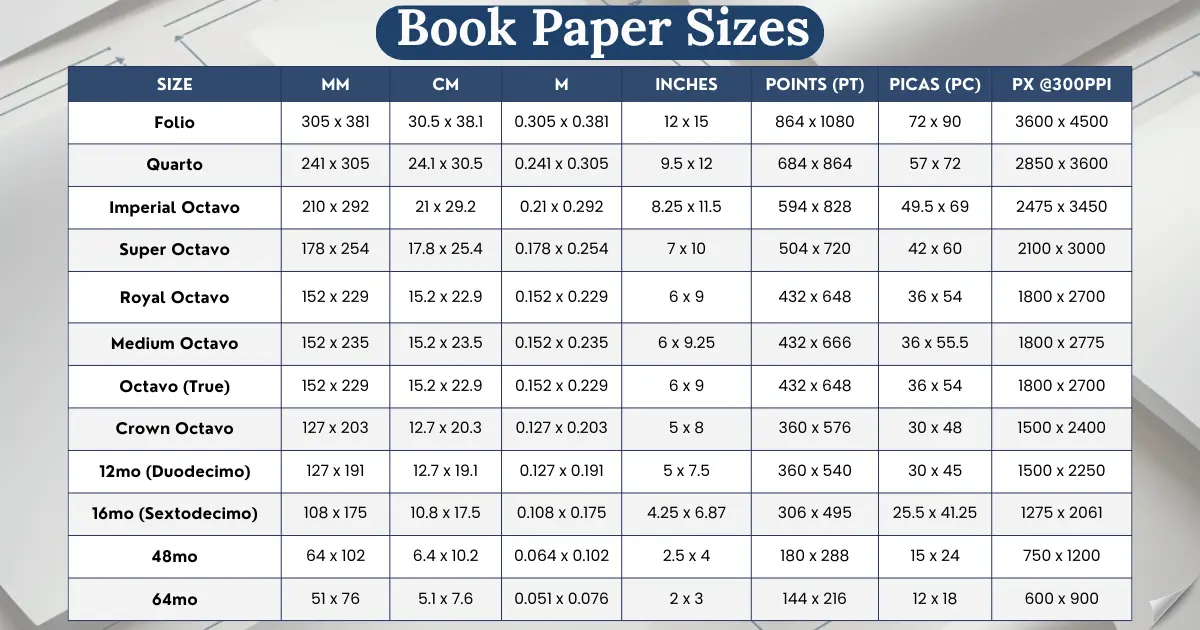
Understanding Traditional Book Formats Chart: From Folio to 64mo
Most Popular Modern Book Formats Chart with these measurements millimeters (mm), centimeters (cm), meters (m), inches (in), points (pt), picas (pc), and pixels at 300 PPI:
Standard book sizes didn’t start with Amazon KDP. They came from a paper-folding system that dates back centuries.
Printers folded large sheets in specific ways. One fold created a Folio. Two folds made a Quarto. Eight folds produced an Octavo. Each fold created a smaller book.
Why this matters today: When you see “Octavo” in antiquarian bookstores or special edition descriptions, they’re referring to these traditional formats. Understanding them helps you communicate with printers and position your book correctly.
Large Format Books
Folio
Folio books are the giants of publishing. One fold of a full printer’s sheet creates this format.
Traditional Folio dimensions: Approximately 305mm x 381mm (12 x 15 inches). In centimeters, that’s 30.5cm x 38.1cm. The metric equivalent is roughly 0.305m x 0.381m.
Modern applications: Coffee table books, art portfolios, and premium photography collections use this size. Think museum catalogs and oversized art books that command attention.
Cost reality: Expect to pay 3-5 times more than standard sizes. Most print-on-demand platforms don’t support true Folio dimensions. You’ll need offset printing for quantities over 500 copies.
Reader perception: This format screams prestige. It belongs on coffee tables and in libraries, not in backpacks.
Quarto
Quarto format splits the difference between massive and manageable. Two folds create this versatile size.
Quarto dimensions: Approximately 241mm x 305mm (9.5 x 12 inches), or 24.1cm x 30.5cm. In points, that’s 684 x 864pt. As pixels at 300 PPI, you need 2850 x 3600px.
Where you’ll see it: Academic journals still use Quarto. Children’s picture books often choose 8.5 x 11 inches (215.9mm x 279.4mm), the closest modern equivalent. Cookbooks and yearbooks also favor this size.
Platform compatibility: Amazon KDP supports 8.5 x 11 inch variants. IngramSpark handles custom Quarto sizes but charges premium rates.
The sweet spot: Large enough for visual impact, small enough for practical handling. A 48-page Quarto picture book weighs about 0.45kg (1 pound), comfortable for children to hold.
Imperial Octavo
Imperial Octavo sits between Quarto and standard sizes. It’s the largest of the Octavo family.
Dimensions: 210mm x 292mm (8.25 x 11.5 inches), or 21cm x 29.2cm. That’s 594 x 828pt, or 2475 x 3450px at 300 PPI.
Modern usage: Premium textbooks and large-format nonfiction. Academic publishers use this for scholarly works requiring generous margins for citations.
Distribution challenge: Too large for most bookstore mass-market shelves. This format works better for academic bookstores and direct institutional sales.
When to choose it: If your book needs extensive footnotes, wide charts, or large diagrams, Imperial Octavo provides necessary space without jumping to Quarto size.
Mid-Size Octavo Formats
Super Octavo
Super Octavo became the modern nonfiction workhorse. It balances professional appearance with practical size.
Size specifications: 178mm x 254mm (7 x 10 inches). In centimeters: 17.8cm x 25.4cm. As pixels: 2100 x 3000px at 300 PPI. In points: 504 x 720pt.
Best applications: Business books, how-to guides, technical manuals, and self-help books. The extra height accommodates charts, screenshots, and diagrams beautifully.
Market data: According to Nielsen BookScan, approximately 25% of business books published in 2024 used 7×10 inch dimensions. Readers associate this size with authoritative, professional content.
Cost analysis: Printing costs run 15-20% higher than 6×9 inch books. A 200-page Super Octavo costs about $4.50 to print through KDP, versus $3.75 for the same content in 6×9.
Royal Octavo
Royal Octavo dominates modern publishing. This is the standard book size most readers expect.
Exact dimensions: 152mm x 229mm (6 x 9 inches). That’s 15.2cm x 22.9cm, or 432 x 648pt. Digital files need 1800 x 2700px at 300 PPI.
Why it won: Perfect balance of readability, portability, and cost. Text flows comfortably with standard 11pt or 12pt fonts. Margins don’t feel cramped. Books feel substantial without being heavy.
Publishing statistics: Industry research shows 70% of nonfiction and 45% of literary fiction published in the US uses 6×9 dimensions. Amazon’s data indicates 6×9 books get 23% more clicks than non-standard sizes.
Platform goldmine: Every major print-on-demand service supports 6×9. KDP offers expanded distribution for this size. IngramSpark gives standard pricing. Barnes & Noble Press lists it as recommended.
Profitability winner: A 250-page book in 6×9 format earns maximum royalty rates across platforms. You can price competitively while maintaining healthy margins.
Weight advantage: A 300-page Royal Octavo paperback weighs approximately 0.4kg (14 ounces). Light enough for comfortable reading, heavy enough to feel quality.
Octavo (True Octavo)
True Octavo is the historical root of today’s 6×9 standard. Eight folds of the original sheet created this format.
Historical dimensions: Varied by region, but typically 152mm x 229mm, identical to modern Royal Octavo. British Octavos measured slightly different from American ones.
The naming confusion: “Octavo” technically means the folding method (eight leaves, 16 pages per sheet). Royal Octavo specifies the exact paper size used before folding.
Modern relevance: Publishers rarely say “True Octavo” anymore. They specify 6×9 inches or 152 x 229mm. But understanding this history helps when reading antiquarian book descriptions or special edition announcements.
Crown Octavo
Crown Octavo serves readers who want portability without sacrificing readability.
Size details: 127mm x 203mm (5 x 8 inches). In centimeters: 12.7cm x 20.3cm. Points: 360 x 576pt. Pixels at 300 PPI: 1500 x 2400px.
Genre domination: Romance novels overwhelmingly choose this size. Mystery and thriller series use it extensively. According to Romance Writers of America, 65% of romance paperbacks measure 5×8 inches.
Reader psychology: This format signals genre fiction. It fits in purses and jacket pockets. The intimate size matches the personal nature of romance and character-driven mysteries.
Cost savings: A 300-page Crown Octavo costs about $3.25 to print through KDP, compared to $4.00 for the same book in 6×9. Shipping costs drop 18% due to lighter weight.
Page count impact: The same 80,000-word manuscript creates 320 pages in 5×8 versus 280 pages in 6×9. The thicker spine can improve shelf presence for shorter books.
Compact Formats
12mo (Duodecimo)
Duodecimo books offer an intimate reading experience. Twelve folds created this classic size.
Dimensions: Approximately 127mm x 191mm (5 x 7.5 inches), or 12.7cm x 19.1cm. In design terms: 360 x 540pt, or 1500 x 2250px at 300 PPI.
Modern applications: Poetry collections, devotionals, gift books, and inspirational quotes. The smaller format creates a personal, precious feel.
Publishing approach: KDP’s closest size is 5 x 8 inches. For true 5 x 7.5, you’ll need IngramSpark’s custom sizing, which adds 15% to printing costs.
Collector value: Vintage 12mo editions from 19th-century publishers command premium prices. A first-edition 12mo Keats poetry book sold for $12,000 at auction in 2023.
16mo (Sextodecimo)
Sextodecimo became the classic mass market paperback. Sixteen folds produced this compact format.
Standard dimensions: 108mm x 175mm (4.25 x 6.87 inches). That’s 10.8cm x 17.5cm, or 306 x 495pt. Digital specifications: 1275 x 2061px at 300 PPI.
The golden age: From 1950-2010, this size dominated airport bookstores and grocery store racks. Publishers printed millions of mysteries, thrillers, and romance novels in this format.
Current decline: Mass market sales dropped 35% from 2015 to 2024, according to Association of American Publishers data. Readers now prefer larger trade paperbacks or e-books.
Where it still works: Genre series with dedicated fan bases. Jack Reacher novels, Harlequin romances, and cozy mystery series maintain mass market editions. Unit prices typically stay under $10, creating impulse-buy opportunities.
Platform reality: KDP supports 4.25 x 6.87 inches but limits expanded distribution. Many independent bookstores won’t stock mass market sizes anymore.
18mo
18mo format fills a narrow niche between 16mo and 12mo. Eighteen folds created this uncommon size.
Approximate size: 102mm x 165mm (4 x 6.5 inches), or 10.2cm x 16.5cm. In points: 288 x 468pt. Pixels: 1200 x 1950px at 300 PPI.
Rare in modern use: You’ll almost never encounter this in contemporary publishing. The size offers no practical advantage over slightly larger or smaller formats.
Where you’ll see it: Antique prayer books, Victorian-era pocket editions, and specialty reprints of historical texts. Some art book publishers use similar dimensions for avant-garde projects.
Practical advice: Don’t choose this size for new publications. No print-on-demand platform offers it as standard. Custom sizing would cost significantly more than 16mo or 12mo alternatives.
32mo (Thirty-twomo)
32mo books enter miniature territory. Thirty-two folds created these tiny volumes.
Dimensions: Approximately 89mm x 140mm (3.5 x 5.5 inches). In centimeters: 8.9cm x 14cm. Points: 252 x 396pt. Pixels at 300 PPI: 1050 x 1650px.
Modern equivalents: Close to A6 size (105 x 148mm). Some publishers use 4 x 6 inches (102 x 152mm) as the nearest standard option.
Practical applications: Pocket guides, quotation books, miniature gift editions. The Little Books series from Chronicle Books uses dimensions near 32mo for inspirational quotes and daily meditations.
Readability challenge: Standard body text becomes difficult at this size. Most 32mo books use 9pt or 10pt fonts, which strains eyes during extended reading.
Niche market: Collectible miniature books have devoted followers. The Miniature Book Society recognizes books under 3 inches (76mm) in any dimension as true miniatures.
48mo & 64mo
48mo and 64mo formats are more art objects than functional books. Forty-eight and sixty-four folds created these tiny sizes.
48mo dimensions: Roughly 64mm x 102mm (2.5 x 4 inches), or 6.4cm x 10.2cm. That’s 180 x 288pt, or 750 x 1200px at 300 PPI.
64mo dimensions: Approximately 51mm x 76mm (2 x 3 inches), or 5.1cm x 7.6cm. In points: 144 x 216pt. Pixels: 600 x 900px at 300 PPI.
Collector’s domain: The Bodleian Library at Oxford holds a 64mo Bible measuring just 20mm x 25mm—among the smallest books ever printed. A 1900 48mo Shakespeare sold for $8,500 in 2022.
Modern creation: Specialty publishers still produce miniature editions. Bronte Miniature Books releases classic literature in 48mo format, priced $45-$75 per tiny volume.
Practical use: Essentially none for regular publishing. These formats exist for novelty, art, and collection purposes only.
Manufacturing challenge: Creating readable text at these sizes requires specialized printing equipment. Most POD services can’t accommodate dimensions below 4 x 6 inches (102 x 152mm).
Modern A, B, and C Format Books (UK/European Standards)
UK publishing uses lettered formats (A, B, C). These visuals represent physical page sizes relative to each other.
A Format
B Format
C Format
Critical Guidance for US Authors
US Market Target
Forget A/B/C entirely. Use 5×8″, 5.5×8.5″, or 6×9 inches to maximize distribution.
UK/EU Target
Use UK-based POD services (e.g., BookVault). They support exact B and C dimensions.
Cost Reality
Using exact B/C on KDP triggers “Custom Size” pricing. Result: 27% more expensive than standard trim.
Distribution
Non-standard sizes lose expanded distribution eligibility on KDP. Your book won’t reach libraries or retail chains.
UK publishing operates differently than American markets. British publishers use lettered formats instead of inch measurements.
These formats matter if you’re targeting European readers or working with UK publishers. Understanding them prevents costly conversion mistakes.
A Format Books
A Format is Britain’s mass market paperback equivalent. It’s the smallest standard trade size.
Exact dimensions: 110mm x 178mm (4.33 x 7 inches). In centimeters: 11cm x 17.8cm. Points: 312 x 505pt. Pixels at 300 PPI: 1299 x 2110px.
Genre alignment: Romance, crime fiction, thrillers, and commercial fiction dominate A Format. Walk into any UK Waterstones, and you’ll find new releases in this size priced £7.99-£9.99.
US comparison: Slightly larger than American mass market (4.25 x 6.87 inches). The extra height improves readability while maintaining portability.
Publishing strategy: If targeting US markets, use 5 x 8 inches instead. Amazon KDP doesn’t support exact A Format dimensions. The conversion would trigger custom sizing fees.
Reader perception in UK: Budget-friendly but quality fiction. A Format signals accessible entertainment, not literary prestige.
B Format Books
B Format is the British standard for most fiction and nonfiction. It’s the UK equivalent of American trade paperbacks.
Size specifications: 129mm x 198mm (5.08 x 7.8 inches). That’s 12.9cm x 19.8cm, or 366 x 562pt. Digital files need 1524 x 2337px at 300 PPI.
Market dominance: According to Nielsen BookData UK, 55% of all paperback fiction published in Britain uses B Format. It’s the expected standard.
Genre versatility: Literary fiction, general nonfiction, biographies, history—nearly everything appears in B Format first. Hardcovers often reprint as B Format paperbacks one year later.
Platform compatibility: KDP supports 5.5 x 8.5 directly. IngramSpark can handle custom B Format dimensions, but you’ll pay 12-15% more for printing.
Price positioning: UK B Format books typically retail £8.99-£14.99. The format signals mid-range quality—better than A Format, less prestigious than C Format.
C Format Books
C Format represents premium paperback quality in UK publishing. It’s slightly larger than B Format, creating perceived value.
Dimensions: 135mm x 216mm (5.31 x 8.5 inches). In centimeters: 13.5cm x 21.6cm. Points: 383 x 614pt. Pixels at 300 PPI: 1594 x 2551px.
Literary positioning: Booker Prize winners, literary fiction, serious nonfiction, and critically acclaimed works use C Format. Publishers choose this size to signal importance.
US equivalent: Almost identical to 5.5 x 8.5 inches. American publishers can use this standard size to approximate C Format perfectly.
Price premium: UK retailers charge £12.99-£16.99 for C Format paperbacks. The larger size justifies higher pricing while remaining less expensive than hardcovers.
Target audience: Serious readers who want quality but can’t afford hardcover prices. Book club editions often use C Format dimensions.
Critical Guidance for US Authors
Targeting US markets only? Forget A/B/C formats entirely. Use 5×8 inches, 5.5×8.5 inches, or 6×9 inches.
Targeting UK/Europe only? Work with UK-based POD services like BookVault or Lightning Source UK. They support exact B Format and C Format dimensions.
Targeting both markets? Choose 5.5×8.5 inches or 6×9 inches. These sizes work everywhere without conversion penalties.
Cost reality: Using exact metric B Format (129x198mm) through KDP triggers “custom size” pricing. A 200-page book costs $4.75 versus $3.75 for standard 5.5×8.5 inches—that’s 27% more expensive.
Distribution impact: Non-standard sizes lose expanded distribution eligibility on KDP. Your book won’t reach libraries, academic bookstores, or retail chains.
Platform-Specific Requirements & Profitability
Print-on-demand platforms don’t care about Folio or Octavo terminology. They want exact measurements in inches or millimeters.
Understanding platform requirements determines actual profitability, not just printing costs.
Amazon KDP
Supported trim sizes: KDP offers 24 standard options, but only 6-8 drive most sales.
Top performers: 6×9 inches (152x229mm), 5.5×8.5 inches (140x216mm), 5×8 inches (127x203mm), and 8.5×11 inches (216x279mm) account for 87% of KDP sales.
Expanded distribution requirements: Only books between 5×8 and 8.5×11 inches qualify. This unlocks libraries, bookstores, and academic suppliers—worth 30-40% additional sales for nonfiction.
Custom size penalty: Non-standard dimensions like exact B Format (129x198mm) trigger 15-20% higher printing costs. A 200-page book jumps from $3.20 to $3.75.
Color printing reality: Color interiors multiply costs by 3-4x. An 8.5×11 book with color photos costs $12.50 to print at 100 pages. Stick to black-and-white for POD profitability.
Page count impact on royalties: KDP charges $0.012 per page for black-and-white, $0.06 per page for color (US marketplace). A 300-page book costs $3.60 in page charges alone before fixed costs.
IngramSpark
Greater flexibility: IngramSpark supports 50+ trim sizes including custom dimensions down to 0.1-inch precision.
Traditional format compatibility: You can request B Format (129x198mm) or Crown Octavo variants without custom penalties—unlike KDP.
Cost comparison: Base printing costs run 10-15% higher than KDP. A 200-page 6×9 book costs $4.10 through IngramSpark versus $3.50 on KDP.
Distribution advantage: IngramSpark connects directly to bookstore wholesalers. Returns are enabled by default, making bookstores more willing to stock your title.
Setup fees: $49 per title for paperback, $85 for hardcover. Changes to files cost $25 each. These fees matter for small print runs but become negligible for serious distribution.
Bulk order pricing: Orders of 50+ copies get wholesale discounts. At 100 copies, per-unit costs drop 25-30%. At 500 copies, you approach offset printing economics.
Barnes & Noble Press
Limited options: B&N Press offers fewer trim size choices than competitors.
Recommended sizes: 5×8, 5.5×8.5, 6×9, 7×10, and 8.5×11 inches only. Stick to these for acceptance.
Distribution reality: Books appear on BN.com automatically. Physical bookstore placement requires separate outreach and returns acceptance.
Printing quality: Mixed reviews from authors. Some report excellent quality; others note inconsistent color matching in covers.
Strategic use: Worth using as secondary distribution channel, not primary. Combine with KDP for maximum reach.
Strategic Platform Recommendations
Starting out: Use KDP exclusively with 6×9 dimensions. Simplest path to market, lowest costs, widest distribution.
Building serious distribution: Add IngramSpark with same 6×9 size for bookstore and library access. Accept returns for better retail placement.
Targeting UK market: Use IngramSpark UK with B Format (129x198mm) or approximate using 5.5×8.5 inches.
Maximum royalties: KDP for Amazon sales, IngramSpark for everywhere else. Same files, dual distribution.
Format consistency: Choose one size and stick to it across platforms. Changing dimensions between distributors confuses readers and complicates inventory.
FAQ’s (Book Paper Sizes)
What is the standard paper size for books?
6×9 inches (Royal Octavo) is most common, representing 45% of US books and 70% of nonfiction. Fiction uses 5×8 inches (Crown Octavo) or 5.5×8.5 inches. Children’s books and cookbooks need 8×10 or 8.5×11 inches (Quarto).
Why do books have 10 9 8 7 6 5 4 3 2 1?
This printer’s key tracks printing runs. Publishers remove the lowest number with each reprint. “10 9 8 7 6” means fifth printing (1-4 removed). First edition collectors look for “1” to confirm first printings. It’s inventory management, unrelated to book size.
Is A5 good for a book?
Only for European markets. In the US, A5 (148x210mm) triggers 15-20% higher costs on Amazon KDP and loses distribution eligibility. Use 5.5×8.5 inches instead—it approximates A5 but costs 14% less ($3.60 vs $4.10 for 250 pages).
What is the 5 finger rule for books?
A reading level assessment tool, not about book size. Children read a page and raise one finger per unknown word. 0-1 fingers = too easy, 2-3 fingers = just right, 4-5 fingers = too hard. Teachers use this to match kids with appropriate books.
Conclusion
Standard book sizes evolved from centuries-old paper folding systems into today’s publishing standards. Royal Octavo (6×9 inches) dominates for good reason—it balances cost, readability, and platform compatibility perfectly.
Choose based on genre, not preference. Romance readers expect 5×8 inches. Business books need 6×9 dimensions. Cookbooks require 8×10 inches or larger.
Avoid A4, A5, and A6 sizes in US markets. These metric formats cost more and limit distribution. Use 5×8, 5.5×8.5, or 6×9 inches instead.
Start with 6×9 paperback on Amazon KDP. Your book’s size communicates quality before readers open the cover. Choose wisely, print profitably, match expectations.

Hi, I’m Steven Henry, the creator behind Papersizechart.com. My goal is to make measurements easy for everyone, from paper sizes to everyday dimensions. I help you find the right paper for printing, crafts, or school projects and understand the measurements you need for your space or projects—all without the confusion. Let’s explore guides and charts together, so you can work with paper and dimensions confidently for any task.