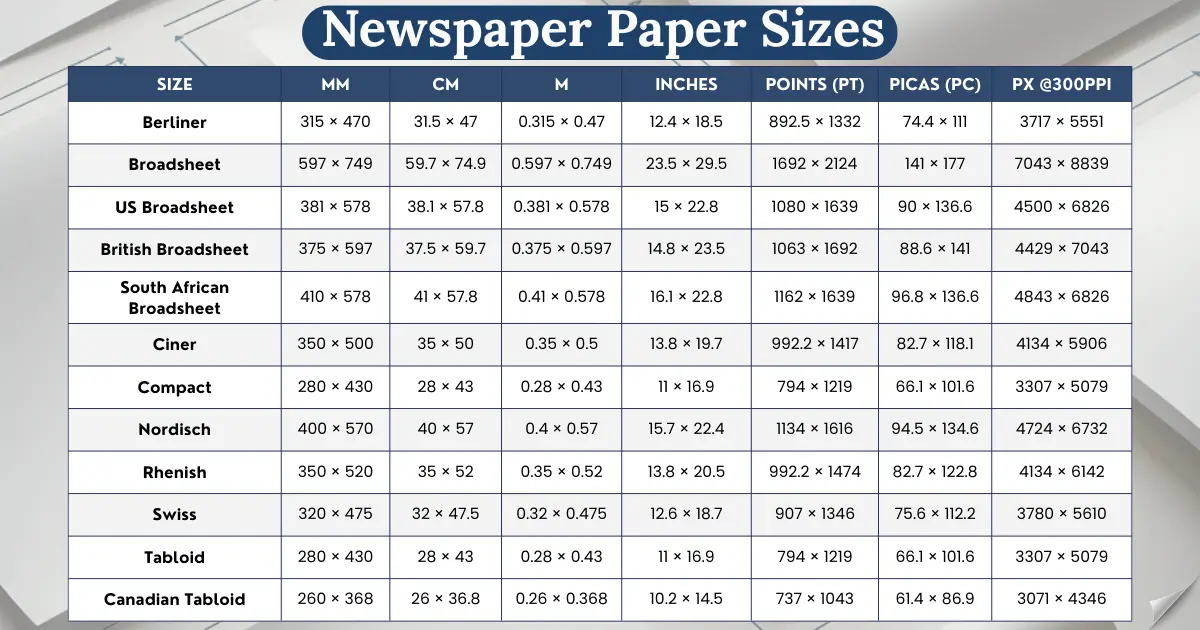
Newspaper paper sizes vary dramatically across the globe. It comes in 15 standard sizes worldwide, ranging from the smallest Canadian Tabloid at 10.2 × 14.5 inches (260 × 368 mm) to the largest International Broadsheet at 23.5 × 29.5 inches (597 × 749 mm).
Different newspaper sizes affect readability, printing costs, portability, and reader perception, with broadsheet formats using 6-8 columns for in-depth content while tabloid formats use 4-5 columns for quick reads.
Understanding these dimensions helps publishers choose the right format based on content volume, target audience, distribution method, and budget, with smaller formats using 50-70% less paper than broadsheet while maintaining professional quality through proper newsprint weights (30#, 35#, 50#), correct bleed settings (.125 inches), and 300 DPI resolution for print-ready files.
15 Standard Newspaper Sizes Chart
Here’s a comprehensive table with all 15 newspaper formats used worldwide and their measurements in every unit:
Broadsheet Newspaper Sizes: The Large Format
Broadsheet is the biggest newspaper size. It looks professional and gives you lots of space for stories.
Standard Broadsheet
The international broadsheet stands as the largest standard newspaper format worldwide. Big international papers like The Telegraph and The Sydney Morning Herald use this size. It measures 597 × 749 mm or 23.5 × 29.5 inches.
You can fit detailed investigative pieces, large photographs, and comprehensive data visualizations all on a single spread.
US Broadsheet
American newspapers use a smaller broadsheet. The typical US broadsheet size ranges from 15″ × 22.75″ to 17″ × 22.75″ wide and about 23 inches tall.
This smaller version maintains the broadsheet prestige while reducing paper costs and improving handling. Major American dailies adopted this format for economic and practical reasons.
British Broadsheet
The British broadsheet carries centuries of newspaper tradition. Historic UK publications like The Times used this format to establish their authority.
This slightly narrower design compared to international broadsheet fits British printing presses perfectly. It measures 14.8 × 23.5 inches (375 × 597 mm).
South African Broadsheet
South African newspapers developed their own broadsheet standard. This format is wider than British but matches US height dimensions.
The unique proportions serve regional distribution needs and local printing infrastructure.
Publications across Southern Africa adopted this specification measuring 410 × 578 mm (41 × 57.8 cm, 0.41 × 0.578 m) or 16.1 × 22.8 inches.
New York Times & Wall Street Journal Sizes
The New York Times created its own custom dimension. This narrower broadsheet variant optimizes for urban newsstand displays and subway reading.
The 12-inch width makes the paper easier to manage in crowded spaces. Yet the 22-inch height maintains that vertical broadsheet authority. Exact measurements are 305 × 559 mm (30.5 × 55.9 cm, 0.305 × 0.559 m) or 12 × 22 inches.
Wall Street Journal Size
The Wall Street Journal matches NYT width but adds height. Those extra 0.8 inches provide crucial space for financial tables and stock data.
This custom newspaper size became the standard for business publications. The format balances portability with the detailed information financial readers demand at 305 × 578 mm (30.5 × 57.8 cm) or 12 × 22.8 inches.
When to Choose Broadsheet Formats
Broadsheet excels for in-depth journalism. If your publication focuses on investigative reporting, complex analysis, or extensive photography, these large formats deliver.
Design advantages include multiple column layouts, large headlines, and comprehensive infographics.
Readers associate broadsheet with quality and thorough reporting. Broadsheet newspapers typically use 6-8 columns across their width, allowing for flexible page design and detailed content presentation.
Tabloid and Compact Newspaper Sizes
Standard Tabloid
The exact half-size of a broadsheet. In the USA, typically measures 11″ × 17″. This variation accommodates different press specifications.
Compact Format
Uses identical dimensions to tabloid but carries a different editorial reputation. Quality papers like The Guardian and The Independent adopted this.
Canadian Tabloid
A smaller tabloid variant developed in Canada. This size reduces paper costs and shipping weight across vast geography while fitting Canadian postal regulations better.
Norwegian Tabloid
Slightly shorter height (400mm vs standard 430mm). This creates a more square proportion that suits local printing infrastructure.
Portability
Commuters can read tabloids one-handed on trains and buses without struggling with unwieldy pages.
Cost Efficiency
Smaller formats use 50% less material than broadsheet per copy. Tabloid layouts work best with 4-5 columns.
Distribution
Shipping costs drop dramatically with reduced dimensions and weight. Fits perfectly in bags, briefcases, and crowded spaces.
Tabloid formats revolutionized newspaper portability. These smaller dimensions fit perfectly in bags, briefcases, and crowded commuter spaces.
Standard Tabloid
The tabloid size is exactly half a standard broadsheet. This mathematical relationship simplifies printing and paper cutting processes.
In the USA, tabloid typically measures 11″ × 17″ or 11.375″ × 17″. This slight variation accommodates different press specifications.
Compact
“Compact” uses identical dimensions to tabloid but carries a different editorial reputation. Quality newspapers adopted “compact” to distance themselves from sensationalist “tabloid” connotations.
The Guardian and The Independent switched to compact format while maintaining serious journalism.
The name change preserved their prestige while offering the same practical benefits. Specifications match tabloid exactly at 280 × 430 mm (28 × 43 cm) or 11 × 16.9 inches.
Canadian Tabloid
Canadian newspapers developed a smaller tabloid variant. This compact size reduces paper costs and shipping weight across Canada’s vast geography.
The 10.2″ × 14.5″ format fits Canadian postal regulations better. Regional publishers across provinces adopted this standard measuring 260 × 368 mm (26 × 36.8 cm, 0.26 × 0.368 m).
Norwegian Tabloid
Norwegian publications use a slightly shorter tabloid. The 400mm height instead of standard 430mm creates a more square proportion.
This Nordic adaptation suits local printing infrastructure. The dimensions balance content space with manufacturing efficiency at 280 × 400 mm (28 × 40 cm, 0.28 × 0.4 m) or 11 × 15.7 inches.
Advantages of Tabloid and Compact Sizes
Portability ranks as the top benefit. Commuters can read tabloids one-handed on trains and buses without struggling with unwieldy pages.
Cost efficiency matters too. Smaller formats use less paper and ink, with tabloid consuming approximately 50% less material than broadsheet per copy.
Shipping costs drop dramatically with reduced dimensions and weight. Tabloid layouts typically work best with 4-5 columns, providing clear content organization without overcrowding.
European and Specialty Newspaper Sizes
Regional newspaper formats developed from local printing traditions. Each size reflects cultural preferences and manufacturing capabilities specific to different parts of the world.
Berline
The Berliner format dominates European publishing. This mid-size option bridges the gap between tabloid portability and broadsheet prestige.
Le Monde, The Guardian (before going compact), and numerous European dailies chose Berliner. The format offers optimal balance for modern readers who want substantial content without excessive bulk.
Berliner measures 315 × 470 mm (31.5 × 47 cm, 0.315 × 0.47 m) or 12.4 × 18.5 inches.
Ciner
Turkish newspapers standardized on the Ciner format. This size is slightly larger than Berliner but maintains similar proportions for comfortable reading.
The 350mm width provides extra column space that works particularly well for Turkish-language typography. Publications across Turkey adopted this regional standard at 350 × 500 mm (35 × 50 cm, 0.35 × 0.5 m) or 13.8 × 19.7 inches.
Nordisch
The Nordisch format serves Scandinavian newspapers with dimensions that closely match US Broadsheet but follow metric standardization.
Nordic countries adopted this format for regional consistency across Denmark, Sweden, Finland, and Norway. The size accommodates both serious journalism and efficient distribution at 400 × 570 mm (40 × 57 cm, 0.4 × 0.57 m) or 15.7 × 22.4 inches.
Rhenish
The Rhenish format originated in Germany’s Rhineland region along the Rhine River. This traditional size sits between Berliner and Nordisch in overall dimensions.
German regional newspapers maintain this format for local identity and historical continuity. The dimensions suit traditional German printing presses perfectly at 350 × 520 mm (35 × 52 cm, 0.35 × 0.52 m) or 13.8 × 20.5 inches.
Swiss
Switzerland’s newspaper standard measures very close to Berliner with slight variations to accommodate Swiss printing specifications and equipment.
Multi-language Swiss publications use this format across German, French, Italian, and Romansh language regions.
The size works effectively for all language layouts and typography requirements at 320 × 475 mm (32 × 47.5 cm, 0.32 × 0.475 m) or 12.6 × 18.7 inches.
Why Regional Formats Matter
Cultural reading habits shape newspaper dimensions more than you might expect. Europeans prefer different proportions than American or Asian readers based on how they consume news.
Printing press infrastructure varies significantly by region. Standardizing on local formats maximizes production efficiency and reduces equipment costs for publishers.
Regional formats also optimize distribution logistics, from newsstand displays to home delivery methods specific to each market.
Choosing the Right Newspaper Size for Your Project
Publishers selecting a newspaper format must balance printing costs against reader preferences. Larger formats like Broadsheet convey prestige and authority but increase production expenses by 35-50% and create distribution challenges.
Tabloid and compact sizes reduce costs by 30-40% compared to broadsheet printing. Urban newspapers targeting commuters overwhelmingly choose portable formats like Berliner or standard Tabloid for subway and bus readability.
Format Selection Guide by Use Case
Advertisers designing for multiple newspapers need precise dimension specifications. A full-page ad for US Broadsheet (381 × 578 mm) won’t fit Berliner (315 × 470 mm) without complete redesign and content adjustment.
Mid-size formats like Swiss, Rhenish, and Ciner offer intelligent compromises. These dimensions provide adequate space for in-depth journalism while maintaining reasonable portability and printing efficiency that satisfies both publishers and readers.
Complete Newspaper Size Comparison Table
FAQ’s (Newspaper Paper Sizes)
What is 24×36 paper called?
24×36 inch paper is Arch D size for architectural drawings, not a standard newspaper format.
What is the largest newspaper size?
The traditional Broadsheet at 597 × 749 mm is the largest standard format.
How big is A3 paper?
A3 measures 297 × 420 mm, nearly identical to the standard Tabloid format at 280 × 430 mm. This makes A3 perfect for tabloid newspaper design mockups and layout development.
What size is A2 paper?
A2 measures 420 × 594 mm. It falls between tabloid and broadsheet formats, similar to British Broadsheet (375 × 597 mm) and US Broadsheet (381 × 578 mm).
Which is bigger, A5 or A6?
A5 is bigger than A6. A5 measures 148 × 210 mm (5.8 × 8.3 inches) while A6 measures 105 × 148 mm (4.1 × 5.8 inches). Both remain much smaller than any standard newspaper dimension, including the compact Canadian Tabloid at 260 × 368 mm.
Conclusion
Newspaper paper sizes range from the massive traditional Broadsheet (597 × 749 mm) to the compact Canadian Tabloid (260 × 368 mm).
Understanding these 15 standard formats helps publishers optimize costs, advertisers design effectively, and readers appreciate global publishing diversity.
The shift from broadsheet to compact formats reflects modern reader preferences and economic realities.
Whether choosing Berliner (315 × 470 mm), US Broadsheet (381 × 578 mm), or Tabloid dimensions (280 × 430 mm), the right newspaper format balances content needs with practical distribution demands for today’s media landscape.

Hi, I’m Steven Henry, the creator behind Papersizechart.com. My goal is to make measurements easy for everyone, from paper sizes to everyday dimensions. I help you find the right paper for printing, crafts, or school projects and understand the measurements you need for your space or projects—all without the confusion. Let’s explore guides and charts together, so you can work with paper and dimensions confidently for any task.