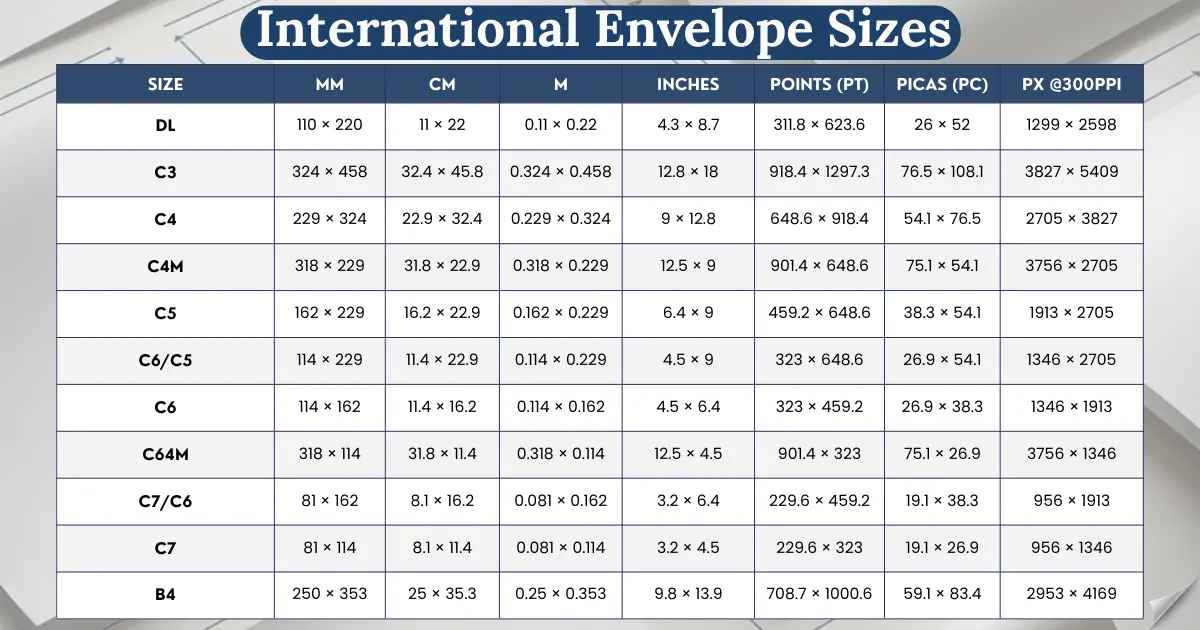
International envelope sizes follow the ISO 269 standard used worldwide, with 28 formats across DL, C-series, B-series, E-series, and specialty sizes (R, S, X) — each designed to perfectly fit A-series or B-series paper, ranging from compact C7 (81×114mm) for small notes to large B4 (250×353mm) for catalogs and brochures.
Choosing the right format directly impacts your USPS postage costs — from the affordable DL letter rate at $1.65 (one Global Forever stamp) to large envelope rates starting at $3.05 for C4/C5/B-series — while proper international addressing format, customs declarations (PS Form 2976), size limits (108-inch combined maximum), prohibited items, and envelope sealing standards all determine whether your mail reaches its destination successfully.
Complete International Envelope Sizes Chart (DL, C Series, B Series, E Series)
International envelope sizes follow the ISO 269 standard, designed to work perfectly with ISO 216 paper sizes. These standardized dimensions ensure consistency across global mail systems.
The most widely used envelope formats include DL, C-series, B-series, E-series, and specialty sizes. Each serves specific mailing needs from compact letters to large document shipments.
DL Envelope – The Business Standard
The DL envelope (Dimension Lengthwise) measures 110 × 220 mm and remains the most popular choice for business correspondence. An A4 sheet folded into thirds fits perfectly inside.
Originally called DIN Lang in 1920s Germany, this format dominates professional mailing worldwide. It’s the go-to size for invoices, statements, and formal letters.
C-Series Envelopes for Standard Documents
C-series envelopes are designed to hold A-series paper without folding. AC4 envelope fits an unfolded A4 sheet, while a C5 holds A5 paper perfectly.
These envelope formats range from tiny C7 (81 × 114 mm) for small notes to large C3 (324 × 458 mm) for posters. The C6 size works great for greeting cards and invitations.
B-Series Envelopes for Larger Documents
B-series envelopes accommodate B-series paper and oversized materials. The B4 size (250 × 353 mm) handles large documents, brochures, and catalogs.
B5 and B6 envelopes serve mid-range needs between standard letter and large format mailings. They’re popular for marketing materials and product catalogs.
E-Series and Specialty Envelope Sizes
E-series envelopes offer unique dimensions for specialized mailing requirements. Sizes like E4, E5, and E6 provide alternatives to standard C-series formats.
Specialty sizes including R7, S-series, and X-series cater to specific industries. The square E56 format (155 × 155 mm) is perfect for invitation suites and premium correspondence.
Paper Compatibility Guide
USPS International Envelope Postage Rates and Stamp Requirements
International mail postage from the USA depends on envelope size, weight, and destination. USPS offers multiple service levels with varying costs and delivery speeds.
Understanding stamp requirements saves money and prevents returned mail. Rates change annually, so verify current pricing before mailing.
How Many Stamps Does an International Envelope Need?
First-Class Mail International letters under 1 oz require $1.65 postage (as of 2026). This equals one Global Forever stamp or three regular Forever stamps ($0.73 each).
Letters weighing 1-2 oz need $2.05 postage, while 2-3 oz letters require $2.45. Large envelopes (flats) start at $3.05 for the first ounce.
International Postage Rate Table (2026)
Can You Use Regular Stamps for International Mail?
Yes, regular Forever stamps work for international mail when combined to meet the required postage. Two Forever stamps($1.46 total) won’t cover international letter mail requiring $1.65.
Global Forever stamps provide better value at $1.65 each. They cover any international First-Class letter up to 1 oz regardless of future rate increases.
USPS Size Limits for International Envelopes
Maximum dimensions for international mail: combined length + height + thickness cannot exceed 108 inches. Individual sides cannot exceed 42 inches in length.
Minimum size requirements: at least 3.5 × 5 inches for letter mail. Smaller items need rigid packaging or will be returned to sender.
Weight Restrictions and Service Options
First-Class Mail International accepts letters up to 3.5 oz and large envelopes up to 4 lbs. This remains USPS’s most affordable international option.
Priority Mail International handles packages up to 70 lbs with faster delivery (6-10 business days). Priority Mail Express International delivers in 3-5 days but costs significantly more.
Customs Forms Requirements
Letters and documents under $800 value need PS Form 2976 (green customs label). This simple form attaches directly to your envelope.
Items over $800 or packages require PS Form 2976-A with commercial invoice. Prohibited items include aerosols, perfumes, lithium batteries, and perishable foods.
Cheapest USPS International Mailing Option
First-Class Mail International offers the lowest rates for envelopes and small packages. Letters under 1 oz cost just $1.65 compared to $45+ for Priority Mail Express.
Delivery takes 7-21 business days depending on destination. Canada typically receives mail in 7-10 days, while Australia and Asia take 14-21 days.
How to Choose the Right International Envelope Size for Your Mail
Selecting appropriate envelope dimensions impacts postage costs and delivery success. USPS charges more for large envelope rates versus standard letters.
Match your envelope size to document dimensions and USPS classifications. Small mistakes in sizing can double your mailing costs.
DL Envelopes for Standard Business Correspondence
DL size (110 × 220 mm or 4.3 × 8.7 inches) qualifies as a standard letter with USPS. An A4 page folded into thirds fits perfectly inside.
This envelope format maximizes postage savings while maintaining professional appearance. Most business invoices, statements, and official letters use DL envelopes internationally.
C4 and C5 Envelopes for Unfolded Documents
C4 envelopes (229 × 324 mm or 9 × 12.8 inches) hold full A4 sheets without creasing. These classify as large envelopes with USPS, starting at $3.05 postage.
C5 size (162 × 229 mm or 6.4 × 9 inches) accommodates A5 paper and qualifies as large envelope rate. Perfect for sending certificates, photos, and important documents flat.
B-Series for Marketing and Brochures
B4 envelopes (250 × 353 mm or 9.8 × 13.9 inches) handle oversized brochures and catalogs. Expect higher postage due to large envelope classification.
B5 and B6 sizes work well for product samples, booklets, and multi-page marketing materials. Consider weight limits when stuffing multiple items inside.
Envelope Size Impact on Postage Costs
E-Series and Specialty Envelopes
E-series sizes like E5 (115 × 220 mm) and E65 (110 × 220 mm) offer alternatives close to DL dimensions. Both qualify for standard letter rates when under weight limits.
Square envelopes like E56 (155 × 155 mm) incur USPS surcharges as non-machinable mail. Add $0.40 extra per piece for square or rigid envelopes.
USPS Classification Quick Reference
Letters must be rectangular, uniformly thick, and flexible. Thickness cannot exceed 0.25 inches to qualify for letter rates.
Large envelopes can measure up to 15 × 12 × 0.75 inches. Anything exceeding these dimensions becomes package rate, significantly increasing costs.
International Envelope Addressing and Preparation for USPS
International Envelope Addressing and Preparation for USPS
Proper addressing format ensures successful international delivery. Follow standardized conventions to avoid delays and returns.
123 YOUR STREET
CITY, STATE ZIP
USA
STREET ADDRESS
CITY PROVINCE POSTAL
COUNTRY NAME
Correct International Address Format
General Rules
- Write the destination address in the center of the envelope.
- Use ALL CAPITAL LETTERS for clarity.
- No punctuation (commas, periods) is necessary.
- Line 1: Recipient Name
- Line 2: Street Address
- Line 3: City, Province/State, Postal Code
- Final Line: Country Name (English, Full Capitals)
Placement Requirements
- Return Address: Upper left corner, same format as destination. Required on all international mail.
- Margins: Leave at least 5/8 inch clear space around all edges for postal barcodes and markings.
- Do Not Obstruct: Do not place tape, labels, or stamps over the bottom 5/8″ clearance area.
Country-Specific Addressing Examples
| Country | Address Format Example |
|---|---|
| Canada | JOHN SMITH 123 MAIN ST APT 4B TORONTO ON M5H 2N2 CANADA |
| United Kingdom | JANE DOE 45 PARK LANE LONDON W1K 1PN UNITED KINGDOM |
| Australia | ROBERT JONES 78 QUEEN STREET SYDNEY NSW 2000 AUSTRALIA |
| Germany | MARIA SCHMIDT HAUPTSTRASSE 12 10115 BERLIN GERMANY |
Customs Declaration
Prohibited and Restricted Items
Cannot Mail Internationally:
Restricted (Varies by Country):
Plants, seeds, food products, medications, and currency. Check USPS country restrictions before mailing.
Envelope Material & Closure
- Opacity: Use opaque envelopes. Transparent or thin materials invite theft and damage.
- Sealing: Seal securely with moisture-activated glue, not just adhesive strips.
- Reinforcement: Reinforce heavy contents with packaging tape along seams.
Tips for Delivery Success
- Legibility: Write clearly in dark ink or use printed labels. Avoid cursive or light-colored pens.
- Markings: Add “AIR MAIL” or “PAR AVION” on the envelope. While not required, these labels speed processing.
- Contact Info: Include sender’s email and phone number inside the envelope so recipients can contact you if delivery fails.
Proper addressing format ensures successful international delivery. USPS processes millions of international letters daily through automated systems.
Follow standardized conventions for address placement and formatting. Small mistakes cause delays or package returns.
Correct International Address Format
Write the destination address in the center of the envelope using all capital letters. Place recipient name on line one, street address on line two.
Include city, province/state, and postal code on line three. Country name goes on the final line in English, spelled in full capitals.
Address Placement Requirements
Return address belongs in the upper left corner using the same format as destination. USPS requires return addresses on all international mail.
Leave at least 5/8 inch clear space around all edges for postal barcodes and markings. Don’t place tape or labels over this border area.
Country-Specific Addressing Examples
Customs Declaration Requirements
PS Form 2976 (green customs sticker) attaches to all international letters containing goods. Check the box indicating letter/document or merchandise.
Declare accurate contents value in US dollars. Underdeclaring value risks confiscation, overdeclaring wastes money on unnecessary duty fees.
Prohibited and Restricted Items
Cannot mail internationally: aerosol sprays, perfumes, nail polish, lithium batteries (alone), alcohol, cigarettes, obscene materials, lottery tickets.
Restricted items varying by country: plants, seeds, food products, medications, currency. Check USPS country restrictions before mailing.
Envelope Material and Closure Standards
Use opaque envelopes that don’t show contents through the paper. Transparent or thin materials invite theft and damage during transit.
Seal envelopes securely with moisture-activated glue, not just adhesive strips. Reinforce heavy contents with packaging tape along seams.
Tips for Ensuring Delivery Success
Write addresses clearly in dark ink, preferably printed labels. Avoid cursive writing, decorative fonts, or light-colored pens.
Add “AIR MAIL” or “PAR AVION” markings on the envelope. While not required, these labels speed processing through international postal networks.
Include sender’s email and phone number inside the envelope. If delivery fails, recipients can contact you directly for clarification.
FAQ’s (International Envelopes)
How many stamps does an international envelope need?
One Global Forever stamp ($1.65) covers international letters up to 1 oz. Alternatively, use three regular Forever stamps to meet the $1.65 requirement.
What is the size limit for international mail?
Maximum combined dimensions: length + height + thickness cannot exceed 108 inches total. No single side can measure more than 42 inches.
How many forever stamps for an international envelope?
Three regular Forever stamps equal $2.19 total, covering international letters up to 2 oz. Two stamps ($1.46) fall short of the $1.65 minimum requirement.
Can I use two regular stamps for international mail?
No, two regular Forever stamps total only $1.46, which doesn’t meet the $1.65 minimum for international letters. Your mail will be returned for insufficient postage.
What is USPS’s cheapest international option?
First-Class Mail International costs just $1.65 for 1 oz letters, making it the most affordable choice. Delivery takes 7-21 business days depending on destination.
Conclusion
Mastering international envelope sizes is not just about picking the right dimensions — it is about making smarter mailing decisions that save money, protect your documents, and ensure reliable delivery across borders. After exploring all 28 formats from the everyday DL to oversized B4, the clear verdict is that folding documents to fit a DL envelope remains the single most cost-effective strategy, cutting postage from $3.05 down to $1.65 per piece.
Ultimately, successful international mailing comes down to four final pillars: choosing the correct envelope size for your USPS classification, stamping accurately with a Global Forever stamp, addressing properly in full capitals with country on the last line, and declaring customs honestly using PS Form 2976 — master these four, and your international correspondence will always arrive professionally, affordably, and on time.

Hi, I’m Steven Henry, the creator behind Papersizechart.com. My goal is to make measurements easy for everyone, from paper sizes to everyday dimensions. I help you find the right paper for printing, crafts, or school projects and understand the measurements you need for your space or projects—all without the confusion. Let’s explore guides and charts together, so you can work with paper and dimensions confidently for any task.