Paper sizing in the United States follows a completely different system than the rest of the world. While most countries use the ISO A-series (like A4), Americans rely on standards set by the American National Standards Institute (ANSI) and specialized formats for different industries.
In this guide we cover all 21 standard US paper sizes, from the common Letter and Legal formats to specialized Architectural and ANSI engineering sizes.
Whether you’re printing everyday documents or working on technical drawings, understanding these dimensions helps you choose the right paper for every project.
Understanding Standard US Paper Sizes
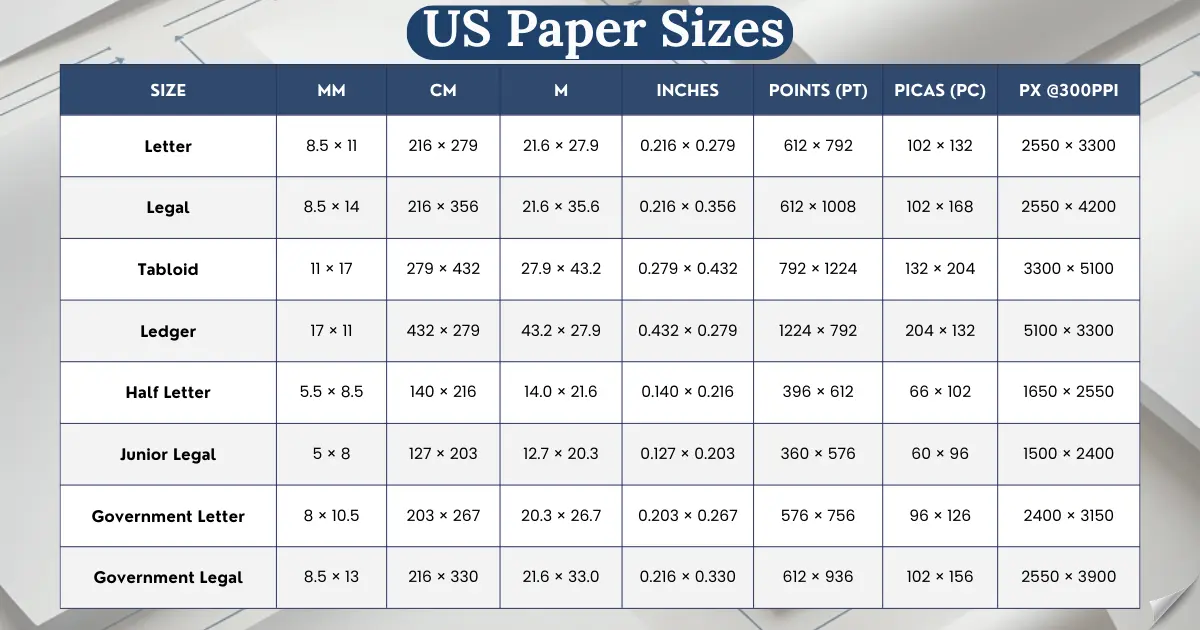
Standard US paper sizes include Letter, Legal, Tabloid, Ledger, and specialty formats measured in inches, millimeters (mm), centimeters (cm), meters (m), points (pt), picas (pc), and pixels at 300 PPI.
The table below provides complete dimensions for all eight core formats, helping you select the right paper size for printing, design, and professional documentation needs.
The Four Core US Paper Sizes every American Should Know
Letter size (8.5 × 11 inches) is the foundation of American paper standards. This format dominates home printing, office documents, business correspondence, school assignments, and resumes.
Legal size (8.5 × 14 inches) shares the same width as Letter but adds three extra inches in length. Attorneys use this format for contracts, pleadings, court filings, wills, and legal briefs.
Tabloid (11 × 17 inches) provides double the area of Letter size when oriented in portrait mode. Publishers use this dimension for newspapers, restaurant menus, newsletters, and small posters.
Ledger (17 × 11 inches) is identical to Tabloid but rotated to landscape orientation. Accountants and data analysts prefer this format for spreadsheets, financial ledgers, and wide tables.
Specialty and Half-Size US Paper Formats
Half Letter (5.5 × 8.5 inches) measures exactly half of standard Letter size. Manufacturers use this dimension for pocket notebooks, personal planners, memo pads, and compact organizers. The portable size fits perfectly in bags and briefcases.
Junior Legal (5 × 8 inches) serves as the compact version of Legal paper. Stenographers and court reporters rely on Junior Legal pads for quick note-taking. The narrow format works well for single-column writing and portable documentation.
Government Letter (8 × 10.5 inches) represents the official paper size for many federal agencies. Government forms, official correspondence, and agency documents often use this slightly smaller format. The dimensions reduce paper costs while maintaining professional appearance.
Government Legal (8.5 × 13 inches) sits between standard Letter and Legal sizes. Federal offices use this format for contracts, regulatory filings, and formal documentation. The one-inch reduction from Legal size helps standardize government printing.
ANSI Paper Sizes: The American National Standards Institute Series (A-E)
What Are ANSI Paper Sizes and Why They Matter?
The American National Standards Institute (ANSI) established a standardized paper series in 1995 through the ANSI/ASME Y14.1 standard. This system creates a scalable progression where each size cuts in half to produce the next smaller dimension.
ANSI sizes solve the aspect ratio problem found in traditional US paper formats. When you cut an ANSI B sheet in half, you get two ANSI A sheets. This consistent scaling benefits engineers, architects, and technical professionals who need proportional enlargements and reductions.
Complete ANSI Size Breakdown with Dimensions
ANSI A (8.5 × 11 inches) serves as the base unit, identical to standard Letter size. Engineers use ANSI A for basic technical documentation, small diagrams, and reference sheets. This size fits standard office printers and copiers.
ANSI B (11 × 17 inches) matches Tabloid/Ledger dimensions exactly. Technical drawings, engineering schematics, and medium-format blueprints commonly use this size. ANSI B provides enough space for detailed diagrams without requiring large-format plotters.
ANSI C (17 × 22 inches) expands to accommodate complex technical illustrations. Mechanical engineers print detailed assembly drawings and architectural floor plans at this dimension. The larger format allows for intricate details while maintaining readability.
ANSI D (22 × 34 inches) handles comprehensive building plans and industrial designs. Construction firms use ANSI D for full building elevations, site plans, and detailed construction drawings. This size requires wide-format plotters or professional printing services.
ANSI E (34 × 44 inches) represents the largest standard ANSI format. Large industrial facilities, shipbuilding companies, and aerospace manufacturers work at this scale. ANSI E sheets display entire factory layouts, massive infrastructure projects, and complex system diagrams.
When to Use ANSI Sizes?
Engineering and CAD professionals default to ANSI standards for technical documentation. The consistent scaling allows easy conversion between sizes when printing reference copies or wall-mounted plans. AutoCAD and other design software include ANSI templates by default.
Manufacturing facilities rely on ANSI D and E sizes for production floor plans and assembly instructions. Workers can read these large-format drawings from a distance, improving safety and efficiency. The standardized dimensions ensure replacement parts and equipment fit existing layouts.
Architectural Paper Sizes (Arch Series)
Why Architects Use Arch Sizes Instead of ANSI
Architectural paper sizes follow different aspect ratios than ANSI formats. The Arch series uses 4:3 and 3:2 ratios, which align better with building proportions and room dimensions. These whole-number ratios simplify scaling calculations during the design process.
American Institute of Architects (AIA) members predominantly use Arch sizes for all project documentation. The format became the industry standard because architectural drawings require different proportions than mechanical engineering diagrams. Interior designers, landscape architects, and urban planners also prefer the Arch series.
The Complete Arch Series Dimensions with Table
Arch A (9 × 12 inches) handles small-scale architectural sketches and detail drawings. Designers use this compact format for presenting specific building elements, material samples, and construction details. The size fits easily in project binders and portfolios.
Arch B (12 × 18 inches) accommodates floor plan sections and building elevations. Residential architects frequently print individual room layouts and exterior views at this scale. The dimensions provide enough detail for client presentations without overwhelming the viewer.
Arch C (18 × 24 inches) serves as the workhorse size for most residential projects. Complete single-family home floor plans, small commercial layouts, and detailed site plans fit comfortably at this dimension. Many architectural firms maintain Arch C plotters in-house for daily use.
Arch D (24 × 36 inches) handles large commercial buildings, multi-story structures, and comprehensive site plans. Construction companies expect full building sets printed at Arch D size. The format displays entire projects while maintaining sufficient detail for builders and contractors.
Arch E (36 × 48 inches) displays major developments, campus layouts, and large industrial facilities. Urban planning departments and commercial developers work at this scale for master plans. The expansive format shows entire neighborhoods or complex building systems in one view.
Extended Arch Sizes (E1, E2, E3) for Specialized Applications
Arch E1 (30 × 42 inches) provides an alternative to standard Arch E when plotting equipment limitations require slightly smaller dimensions. Some wide-format plotters handle E1 better than full E size. This format maintains the 3:2 aspect ratio preferred in architectural work.
Arch E2 (26 × 38 inches) fills the gap between Arch D and Arch E for mid-scale projects. Mixed-use developments and medium-sized commercial buildings often work well at this dimension. The size reduces plotting costs while providing more space than Arch D.
Arch E3 (27 × 39 inches) represents another intermediate option with specific plotter compatibility advantages. Certain large-format printers optimize for E3 dimensions, reducing waste and improving print quality. Landscape architects sometimes prefer this size for site plans.
Choosing the Right US Paper Size: Practical Selection Guide
Choosing the Right US Paper Size
Practical Selection Guide & Decision Framework
Personal & Home
Stick with Letter size for 95% of printing needs. Resumes, school papers, and personal correspondence all default to 8.5 × 11 inches.
Half Letter works perfectly for grocery lists, to-do lists, and compact note-taking.
Business Professionals
Letter for standard correspondence. Legal for contracts requiring signatures and witness statements.
Marketing departments favor Tabloid for brochures, menus, and promotional materials.
Legal & Government
Attorneys print pleadings and contracts on Legal size. Federal agencies standardize on Government Letter for official forms.
Using Government Letter reduces paper costs across departments.
Architects & Designers
Work exclusively within the Arch series. Residential projects use Arch C and D; commercial developments require Arch D and E.
The 4:3 aspect ratio matches building proportions naturally.
Engineers & Technical
Rely on the ANSI series for CAD drawings. Small companies use ANSI A and B; large firms invest in plotters for ANSI C through E.
Enabling in-house production of construction documents.
Buying & Printer Compatibility Tips
Standard Home & Office
- Printers: Home printers handle Letter and Legal without modification. Most consumer models include a Legal setting.
- Tabloid: Requires specialized wide-format printers starting around $300.
- Sourcing: Office supply stores stock Letter, Legal, and Tabloid readily.
- Specialty: Sizes like Half Letter, Junior Legal, and Government formats require ordering from commercial suppliers.
Large Format Requirements
Large-format plotters become necessary for ANSI C and larger, plus all Arch sizes beyond Arch B.
Entry Level
24-inch Plotters
$1,000 – $2,000
Handles up to ANSI C / Arch C
Professional
36-inch & 44-inch
$3,000 – $10,000
Prints ANSI D/E and Arch D/E
Cost Per Sheet Analysis
Cost per sheet increases substantially with size. Below is an estimated breakdown.
*Note: Costs vary based on paper quality and printing service.
Decision Framework by Use Case
Personal and home users stick with Letter size for 95% of printing needs. Resumes, school papers, personal correspondence, and household documents all default to 8.5 × 11 inches. Half Letter works perfectly for grocery lists, to-do lists, and compact note-taking.
Business professionals choose Letter for standard correspondence and Legal for contracts requiring signatures and witness statements. Marketing departments favor Tabloid for brochures, menus, and promotional materials.
Legal and government offices maintain stocks of both Legal and Government Letter sizes. Attorneys print pleadings, contracts, and discovery documents on Legal size. Federal agencies standardize on Government Letter for official forms and correspondence, reducing paper costs across departments.
Architects and designers work exclusively within the Arch series. Residential projects typically use Arch C and D, while commercial developments require Arch D and E. The 4:3 aspect ratio matches building proportions naturally, simplifying the design workflow.
Engineers and technical professionals rely on the ANSI series for all CAD drawings and technical documentation. Small companies print on ANSI A and B using standard office equipment.
Buying and Printer Compatibility Tips
Standard home printers handle Letter and Legal sizes without modification. Most consumer models include a Legal setting in print properties. Tabloid printing requires specialized wide-format printers starting around $300 for basic models.
Office supply stores stock Letter, Legal, and Tabloid readily. Specialty sizes like Half Letter, Junior Legal, and Government formats require ordering from commercial paper suppliers or online retailers. Bulk purchasing reduces per-sheet costs significantly for businesses.
Large-format plotters become necessary for ANSI C and larger, plus all Arch sizes beyond Arch B. Entry-level 24-inch plotters cost $1,000-2,000 and handle up to ANSI C/Arch C. Professional 36-inch and 44-inch models run $3,000-10,000 but print ANSI D/E and Arch D/E sizes.
Cost per sheet increases substantially with size. Letter paper costs 1-2 cents per sheet. Tabloid/ANSI B runs 5-10 cents. ANSI C and Arch C cost 25-50 cents each. ANSI D/E and Arch D/E can exceed $1-2 per sheet depending on paper quality and printing service.
FAQ’s (US Paper Sizes)
What are standard US paper sizes?
The three most common standard US paper sizes are Letter (8.5 × 11 inches), Legal (8.5 × 14 inches), and Tabloid/Ledger (11 × 17 inches). Specialized applications use ANSI engineering sizes or Architectural (Arch) sizes.
Is A4 size paper available in the USA?
Yes, A4 paper is sold throughout the United States at office supply stores, online retailers, and specialty paper shops.
What is A1, A2, A3, and A4?
These represent sizes in the international ISO 216 standard. A1 (594 × 841 mm) works for posters and large displays. A2 (420 × 594 mm) suits medium presentations. A3 (297 × 420 mm) handles tabloid-style layouts. A4 (210 × 297 mm) serves as the standard international letter size, similar to US Letter.
Conclusion
Choosing the right paper size directly impacts printing costs, document presentation, and professional appearance. Letter handles everyday needs while Legal accommodates contracts and ANSI/Arch series serve technical professionals.
International collaboration requires understanding both US and ISO systems. The 21 formats covered here—from compact Half Letter to expansive Arch E—ensure your documents print correctly and serve their intended purpose effectively.

Hi, I’m Steven Henry, the creator behind Papersizechart.com. My goal is to make measurements easy for everyone, from paper sizes to everyday dimensions. I help you find the right paper for printing, crafts, or school projects and understand the measurements you need for your space or projects—all without the confusion. Let’s explore guides and charts together, so you can work with paper and dimensions confidently for any task.